
Client Expectations vs Reality
I've run in to a number of situations where after a gig someone will ask if I got a specific shot. So specific, I wonder why they didn't ask for exactly that before I started taking pictures or even while I was working.
Photography is an art, or skill, that comes in a lot of different forms. Events, concerts, portraits, food, interiors, exteriors, sports, weddings, etc, different projects require different equipment, even a different mindset. I do as much pre-production before a gig as I can, no matter what the job is. I sit down, I think about what's required, I do a little research if need-be. I make a list of gear I'll need, shots I know I'll have to take, and maybe a wishlist of other things I'd like to see the day of the gig. I love it when a client gives me a shot list before an event, that cuts my pre-production time in half. I know exactly what they want and there should be no surprises the day-of. Unfortunately, that kind of preparation is rare.
I've run in to a number of situations where after a gig someone will ask if I got a specific shot. So specific, I wonder why they didn't ask for exactly that before I started taking pictures or even while I was working. The most common is a shot of a single person at an event, with no one near them. This shot is nearly impossible to do by accident and must be established before I start shooting. For instance, I shot an event where a person desperately wanted a shot of just them, alone, at their own birthday party. Surprisingly, I had that. We had taken a few pictures of them alone, because they had requested it while I was there. Perfect! But that demand turned from "do you have a shot of me alone" to "do you have a shot of me with my whole outfit in view." I managed to crop another image to just this person, full outfit in view. But the shoes weren't in the shot, which turned out to be a problem. I had other shots of this person, full outfit with shoes in frame, but someone was standing arm-in-arm with them, they wanted a solo shot.
So lets recap. It's a birthday party with many attendees. This person wanted a solo shot, head-to-toe portrait facing the camera, with nobody even behind them in the background. This goes against everything I'd expect to accomplish at a party environment. For parties and events, I do try to get head-to-toe pictures. A full outfit shot looks great. But another major goal for me is to make the party look lively. This means group shots, or groups of people behind someone. I'm not there to do portraits, that's an entirely different animal all together. Imagine you have a plumber come fix your toilet. They fix the toilet but you ask why they didn't fix the sink too, after the plumber had already left. Had they asked the plumber while they were there, the plumber could've fixed the sink no problem. But it wasn't in the job outline, how could they have known to fix the sink?
This birthday party isn't the only time this has happened. Many other party throwers have asked for something similar, but after I had already submitted my final edits. Or shots of the entire venue. That's a tough shot, considering many events are in dark environments. I would need a tripod and maybe a few flashes on stands around the room. It's a rare request, but it's happened enough where I now send a small shot list of things I plan on photographing, and the client can add to it if they need to.
My criticisms from my event photography are, thankfully, few and far between. Even those criticisms come with tremendous gratitude for what I delivered. Nobody has been truly upset with me and I certainly don't look forward to the day where that inevitably happens. But when they ask for someone specific that I didn't get, I can't help but feel I failed in some way. Why didn't I think to do that? Did they tell me to get that and I just forgot? When talking to another photographer about this, my eyes were opened to the truth. I had sent him shots from an event I covered where someone had ask for something specific. After looking at my pictures, he said "event photography isn't a photoshoot. You're there for the event, and you captured exactly what was required."
It's still difficult for me to tell someone I don't have a picture they wanted. But if I don't know what they want beforehand, how do I know what I'll need at the gig? I certainly can't carry all of my gear with me wherever I go. If I'm photographing an event, I'm not going to bring a set of 3 lights as if I'm doing portraits. If I'm doing food photography, I'm not going to bring my 70-200mm f/2.8L. If I'm doing a day time outdoor sporting event, I'm probably not going to bring my flash. No matter how much prep I do, there will always be something I can't capture. The best I can do is capture all that I can and not worry about the misses.
You Know What You Should Get?
Photography is one of those things that is a hobby for most and a job for few. Much like playing a musical instrument, the majority do it for the fun of it and the minority get paid to do it. But nothing is stopping hobbyists from buying the pro stuff, it's available to all as long as you have the money.
Photography is one of those things that is a hobby for most and a job for few. Much like playing a musical instrument, the majority do it for the fun of it and the minority get paid to do it. But nothing is stopping hobbyists from buying the pro stuff, it's available to all as long as you have the money. Much like music, photography has "gear heads" or people who know all the latest and greatest gear and just have to have it. I call this, and I'm not alone in calling it, "gear acquisition disorder." You hear the new thing is coming out, you read all about it, now you gotta get it. But do you need it?
Perhaps it's a symptom of growing up with little money, but I've always been happy with the stuff I have and rarely wish for the new thing. That is, until I started getting in to board games. For some reason I always wanted the newest thing to hit the market. Anything on the top 10 of The Hotness list on boardgamegeek.com, anything that was reviewed positively on the blog Shut Up and Sit Down, and anything that looked remotely fun on Wil Wheaton's TableTop series, I had to have it! I couldn't stop myself from wanting the new cool thing. I would even tell friends which ones they should get. Then I realized I've become exactly the kind of person I hated. The "you know what you should get?" guy.
"You know what you should get? [insert the most expensive, newest thing in your area of interest.]" Everyone has experienced this person, or perhaps you are that person. For the most part I think that person is just trying to make conversation. Or maybe they're tying to legitimize themselves, showing off that they know the newest gear and wondering if you do too. I used to be filled with self doubt when someone would tell me I should get the newest and best thing. It made me question my gear and my ability to perform the job I needed to do. Until I met someone who made me feel better about myself.
I won't use their real name, but for the sake of the story lets call them Lenny. Lenny was pretty new to the world of photo and video but he was a fast talker and had some decent gear. I ended up working with him on a few projects, mostly things he brought me in on. He's great at talking and would somehow land jobs at a pace I can only dream to match. I was happy he thought of me to bring in as camera 2, but every time I saw him he had a new piece of gear and he'd tell me all about it and would suggest I get the same thing. The problem is, it's very rare I have enough money lying around for me to buy new gear. At the time, I had no idea how Lenny had so much money, I assumed he worked a lot. But later I wondered if his family had money. Which isn't a bad thing, it just changes the perspective a bit.
I often felt bad after leaving a job I worked with Lenny. He was better at talking and had better gear. I was just the lowly lackey. There were two live shows I did video for on a regular basis and just so happened that each show needed 1 more video person. So I brought Lenny in because I'd worked with him a lot. These were shows I was in strong standing with and they were happy that I was able to bring someone in quickly and easily. I figured it would strengthen my bond with the shows, bringing in someone with hot gear and works a lot, and Lenny would bring me in on more work. Win-win for me! That is until Lenny and I shot both shows twice.
Up until this point, I had never seen anything Lenny had shot. He had never sent me anything he had done and I always had my own footage and photos from a show to keep for my own portfolio, I didn't need to see Lenny's. The first time I saw Lenny's work was when one of the shows sent me some video from Lenny's camera and asked me what was up with Lenny? I was totally shocked, Lenny's footage was pretty much unusable. I asked the second show how Lenny's footage looked and they said it looked awful too. Apparently both shows wrote off the Lenny's first set with them as a simple mistake. The footage looked bad, but at least they had mine, and perhaps Lenny hadn't noticed something was off. But when he did it a second time, a red flag was raised. I couldn't believe it. Lenny had all this gear, and spouts a ton of knowledge, but apparently didn't know the basics of how to use it.
This made me rethink all these negative things I thought about myself over the past months or even years. It was an incredible boost of self confidence. It proved that I didn't need the newest version of my gear to get the job done. My gear isn't even bad, it's actually very good, but it's easy for someone to ask "why don't you have the newest thing?" A little bit of schadenfreude goes a long way. But just because someone has the latest and greatest, doesn't mean they're better or more experienced than you. I haven't worked with Lenny since then. I've barely even spoken to him. We're still friends on Facebook but I don't see his posts very often. I tried going to his website but it doesn't load. I take no pride in believing Lenny has given up on photo and video but perhaps he has learned it's not as easy as just pointing the camera in the right direction.
You can have all the best gear, spend thousands of dollars investing in camera bag filled with the best stuff. But if you don't know how to use it, it's worthless. Only buy the new stuff when you deem it necessary. Never let someone tell you your gear is outdated and you should get the new thing. There's a time and a place to upgrade and only you know when to do it, because you're the one using the gear. Don't let someone else's self-doubt become your own. It took me a long time to learn that, but after working with Lenny and a few other people, I've never been happier.
The Live Show and the LED Nightmare
When I was a kid, lighting wasn't a thing. I went to a lot of shows in basements or in crummy, low-budget venues, where the lights were literally an exposed bulb hanging from the ceiling, or work lights. Pro lighting equipment is expensive! Even amateur show lights are expensive! Until now...
I shoot a lot of live shows, either for fun or professionally. I love the live experience and I'm very rarely disappointed when seeing any live band or someone performing live. Something about the experience of seeing someone do their thing excites me. I've been going to shows since I was a teen, even playing a few bands along the way, and during that time I'd sometimes borrow my school's video camera and I'd record shows. For no real reason, I just liked being behind the camera and liked live shows, so I married the two interests and that has carried on with me 15 years later.
When I was a kid, lighting wasn't a thing. I went to a lot of shows in basements or in crummy, low-budget venues, where the lights were literally an exposed bulb hanging from the ceiling, or work lights. Pro lighting equipment is expensive! Even amateur show lights are expensive! Until now...
LED lights have been popping up in every venue. They're cheap, safe, don't generate a lot of heat, and are pretty damn bright and vibrant. They're great for a budget venue not looking to break the bank on lighting and maybe, HOPEFULLY, spend a little bit of those savings on sound equipment. The problem is, for photographers, something about LED lights look insane on digital censors.
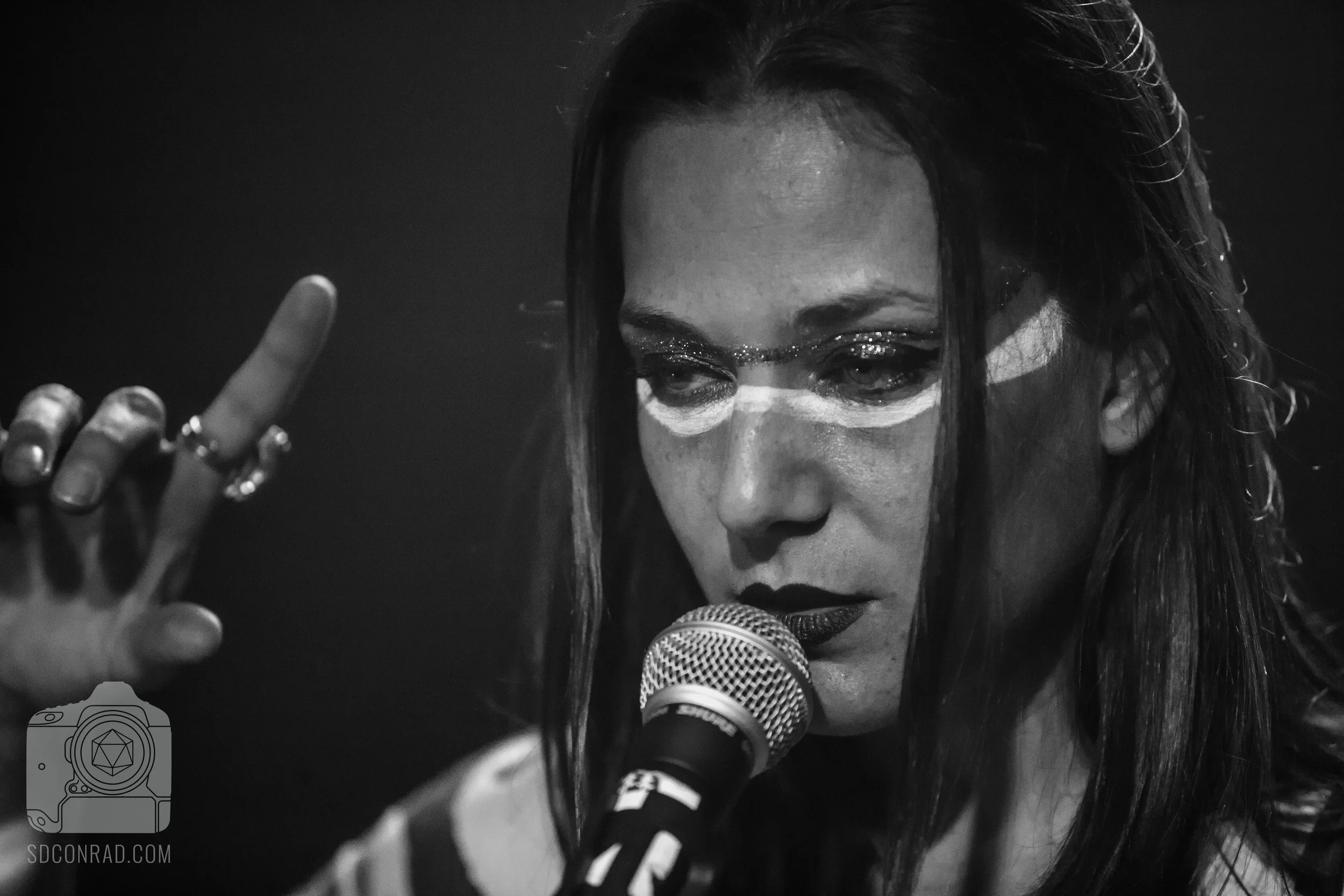
The above picture is from a few weeks ago when I went to C'Mon Everybody in Bushwick to see my friends We Are the Wilderness. This particular photo isn't the best example of how LED lights mess with an image but you can see how the detail in Shanda's face is softened by the light. The hope of bringing natural skin color back is totally out of the question. But you don't always want to white balance that way at a live show, part of the experience of the live show is the colorful lights. But I want that texture to come back. The easy solution for me is to make it black and white and go from there.
This is what I came up with. Overall, the LEDs weren't an issue to work with. The real issue is when someone is using a lot of different color LED lights and trying to recreate white light. Or just aren't even trying to recreate white light and they're just cranking everything they have up to 11.
Again, this isn't the worst example I have. I don't want to share my worst examples because I don't want to ruin relationships with venues, I think it would make me look bad just as much as them. But this is a situation I run in to frequently. These lights don't look like this to the naked eye. No matter how I white balance my camera at the show, I end up with a wash of colors to contend with. For this show I try to bring it back to natural skin tone/white light, because it's an "intimate" show with a lot of jokes and talking. Not really the type of place I'd expect to see wild rock n' roll stage lighting. The problem here is, there are so many colors, you can't just do an overall image white balance. I started my white balance by using my White Balance Selector tool on Nat's collar. This got me close to my final white balance, but it still needed a lot of work.
Colors... colors everywhere. But his skin is starting to return to his natural skin color. The issue now is taking the final steps to get his skin back to normal and getting the backdrop to turn white. But yellow/red/orange, are all colors that you find mixed in with Caucasian skin. The background is also yellow/green/blue something. If I adjust yellows, I'm going to be adjusting both the background and the skin. While editing I was constantly going back and forth between all these different colors, adjusting hue and saturation, until I ended up with something I decided was reasonable, but still not perfect.
This is where I ended up stopping. It's about as natural as I could make it but it still has a bit of the live show charm. There's a point where you just have to stop editing otherwise you'll end up editing for days. I'm not saying I gave up, far from it. I'm happy with the final picture even though I see things that bother me. But perhaps the viewer won't see those things? As a matter of fact, I know the average viewer will not point out the flaws that I see. They might even see other things that are flawed with the final picture! But I did the work I set out to do and I believe I succeeded. It's a wrestling match with LED lights and you can't expect to walk away from the fight without a few wounds. But with each edit I do with LED lights I learn something knew about them and I use it for next time. As lights evolve, so should the photographer. LED lights are here to stay, so we have to adjust.
What is this?
I am a freelance photographer and this blog is about my life as such. Sometimes I just need to vent. Sometimes I need to write down my thoughts to remind myself how I should be working. Other times I might just want to write about how I love my dog.
Why is this?
I believe it's important to get your thoughts out of your head sometimes. Some people write a journal for their own safe keeping. Other see therapists. I'm going to share my thoughts with the public. Feel free to communicate with me!