
Sports Photography... at Night!
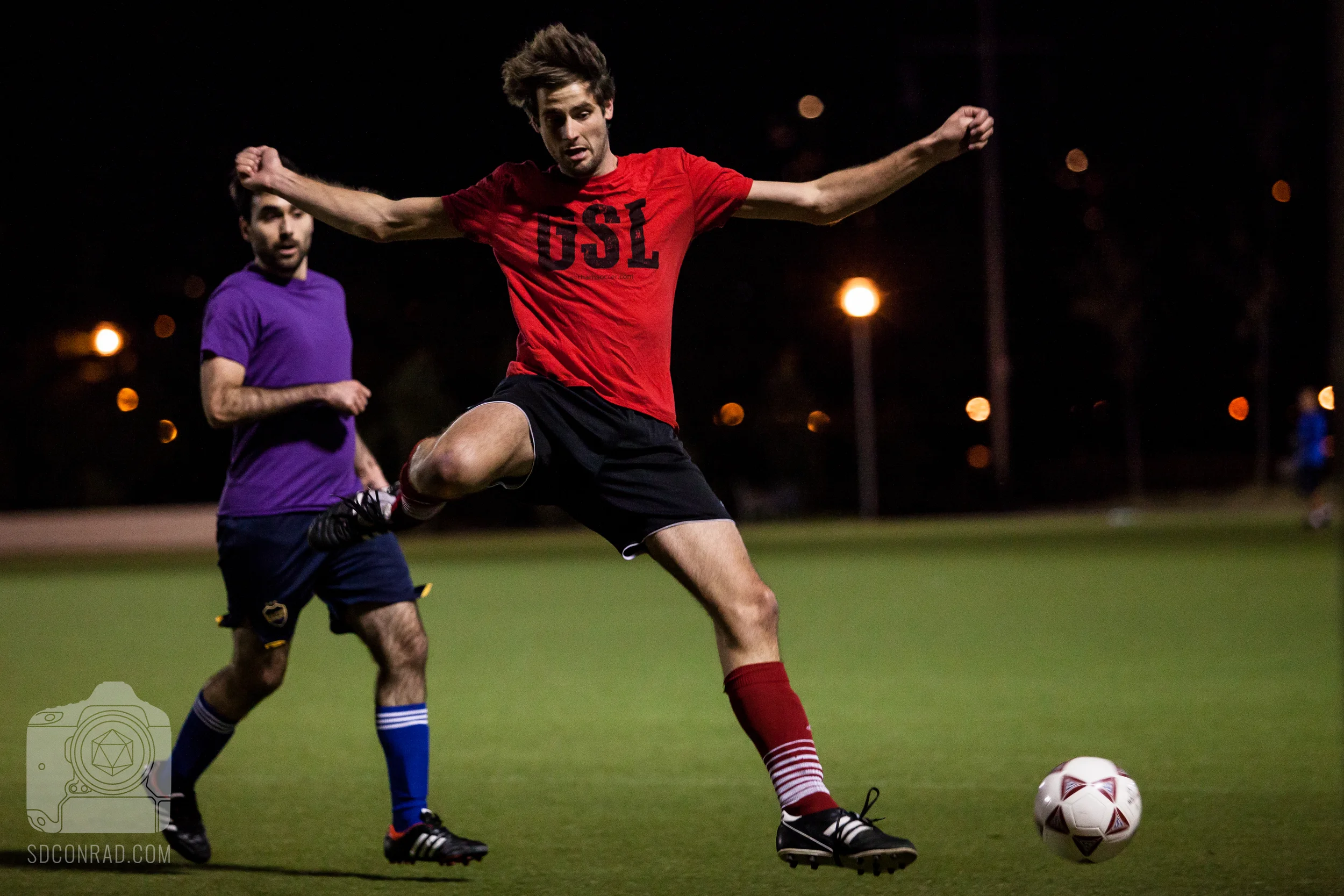
Successful sports photography requires pretty much only one thing... a high shutter speed. We're talking upwards of 1/1000th of a second. The problem is, a fast shutter speed like that requires a lot of light.
Successful sports photography requires pretty much only one thing... a high shutter speed. We're talking upwards of 1/1000th of a second. The problem is, a fast shutter speed like that requires a lot of light. With the power of the Sun, you won't have to worry about much, that's pretty much a no-brainer. But once the Sun goes down you have to make your own light sources. Photographers do this regularly with their own lights or with lights they rent. They can control them by moving them around, adding filters, flags, scrims, silks, whatever you have to throw in front of the light, it's up to you to use. There are unfortunate circumstances where you are required to shoot in a dark place and you have absolutely no control over the light. This is the challenge I've been facing once a week for the past month as I've been photographing for Gotham Soccer League.
While the fields they use are illuminated, these are not professional stadiums they're playing in, so they're still a little dim for my liking. One challenge I've faced is that I have to decide between a really high ISO, practically the maximum ISO my camera can handle, meaning all the shots will have more "noise." This will allow me to use a higher shutter speed, reaching my target of 1/1000th of a second. Or I can use a lower ISO, experiencing less noise, but I might encounter some motion blur. I decided a little blur isn't the end of the world, as motion blur in sports simply shows motion. I mean, these are action shots after all. The 1/1000th of a second shutter speed will stop time. So sometimes I switch back and forth getting a little with more blur and a little without.
For these games I shoot at an aperture of f/2.8. This allows for more light to hit the censor and creates a nice depth of field. The only issue is that, depending on the subject's distance from the camera and what millimeter my camera is zoomed to, the depth of field can sometimes be pretty narrow. When a player is running directly at me, I only have about of meter or less for them to be in focus. So I often hold my autofocus button (which I've remapped to the back of my camera) and hold the shutter down and hope for the best. It's during free kicks and goal kicks when I can take my time to set frame and focus.
One important thing to include in sports photography is the scenery. As I stated before, I'm not shooting in stadiums. There's rarely an audience and usually it's just friends and family of the people playing. These players are playing for the love of the game, not for the fame and fortune that comes with being an athlete. But, we do live in NYC, which offers amazing views from time to time. After living here for years it's easy to forget the beauty the city has to offer.
"Your Camera takes Beautiful Pictures!"
I'd like to think I play a large part in what goes in to the camera because I can tell you first hand that I take a lot of bad, bad pictures. I only share the ones I like.
After seeing my pictures I sometimes hear people say "your camera takes beautiful pictures!" I get what they're saying but I can't help but hear "if it wasn't for your camera your pictures would be bad." I agree, my camera has the capacity to capture a beautiful image, but I'd like to think I play a large part in what goes in to the camera because I can tell you first hand that I take a lot of bad, bad pictures. I only share the ones I like.
I'm going to do something risky - I'm going to show you a bad picture I've taken. I decided to go with a product shot since I don't want to make a person look bad. I recently did some product photography for a local pipe shop and it was a challenge photographing the pieces. Photographing glass is a tricky thing so it took a few bad shots in order to get to a good one.
This was my first test shot. As you can see, it's blown out and the focus is questionable. It's overall not appealing. I don't think anyone would look at this and say "your camera takes beautiful pictures!" They'd say "this is a bad photo" and the full blame would be on me. Rightly so.
This is an unedited version of what ended up being my final look for this piece of glass. It's an unremarkable image but you can see the improvement between the last picture and this one. Focus is there, exposure is perhaps a touch under but it's acceptable, and you can see the full piece unobstructed. Still, not an image you'd call beautiful.
This is the final edit of the above picture. Vibrant, detailed, and all you can see is the piece itself. The camera does maybe 1/4 of the work. It captures all you need to create a beautiful image, but it ultimately rests on the shoulders of the photographer to make it all happen. You can buy the most expensive camera on the market and still take terrible pictures.
If a chef makes you a delicious meal would you say "your oven makes a great dish!" A tool is only as useful as the person wielding it. I don't profess to be a prolific photographer but I do appreciate recognition when it comes. When someone says my camera takes nice pictures I can't help but feel insulted. I know they don't mean to be insulting, and I don't take a personally, but next time you want to compliment someone on their work, compliment them, not their tools.
SMOKIN'!
I have a hard time going through my old pictures. I've learned a lot over the years and sometimes I look at old pictures and think "man... what was I thinking!?" But sometimes there are projects where I look back and think "man... what was I thinking? How did I do that and how can I repeat it!?"
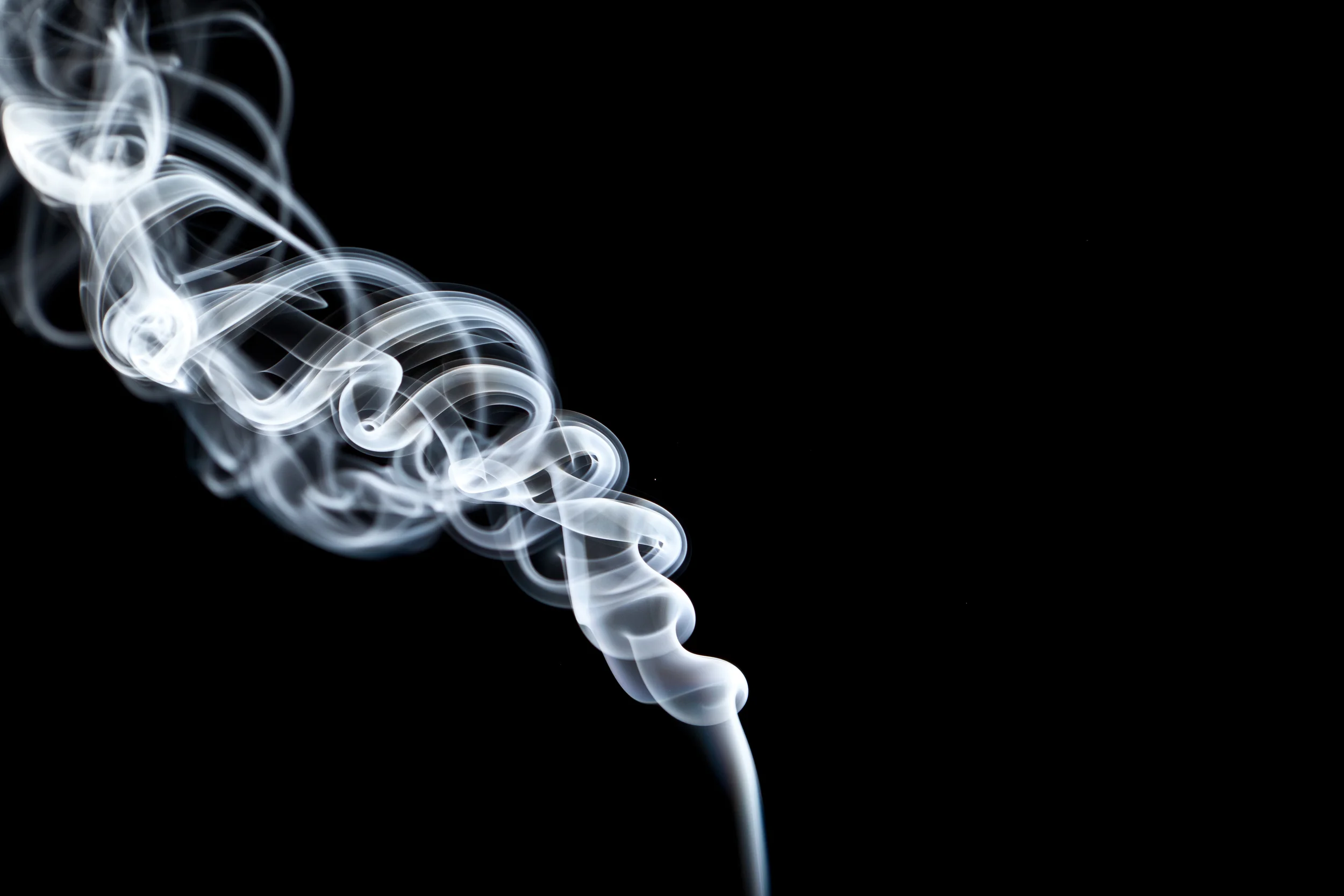
I have a hard time going through my old pictures. I've learned a lot over the years and sometimes I look at old pictures and think "man... what was I thinking!?" But sometimes there are projects where I look back and think "man... what was I thinking? How did I do that and how can I repeat it!?" One of those projects was from the Summer of 2014. Some friends of mine have been painstakingly working on a comic book. But it's not just like any ol' comic book you'll find at your favorite store. This one is a massive project. Painted by hand in an oversize book. The artist was feeling uneasy about how his smoke was turning out and needed some reference material. Instead of just looking online we decided to photograph some incense smoke ourselves so we could try different effects to see how the smoke moved and responded to different situations. I had never done anything like it so of course I was on board to give it a shot. What we came up with blew my mind.
ISO 200 - 70mm - f/5.6 - 1/125 sec
That is the test picture I took while the painter and writer where in the other room talking. It's completely unedited (if you read my last blog post you'll see me say I never show unedited pictures, so I'm a bit of a hypocrite right now but I'm showing this for a reason) and it came as a complete shock to me. I literally gasped and called for the others to take a look at this. We were all incredibly excited for the project and started working immediately. So, what'd I do to take this picture?
I spent a lot of time planning for this project. As I said before, I had never done anything like it. First thing I thought was - how do you isolate smoke from the background? I thought, well, smoke is white, we need a black background. But it couldn't be just any sort of black background. Black construction paper? I would need a big piece, or many pieces taped together. I don't know, that sounds like too much trouble and it probably wouldn't work. I could paint my wall black? But returning it to a lighter color would take a lot of paint. Also, I would need matte black, any reflection would be tough to deal with.
Then it hit me. Black velvet! Black velvet is known for being a deep dark black and absorbs light. I went to a local craft store and was expecting to spend a small fortune, I have no idea how much black velvet costs or if it's even easy to come by. Turns out, it's cheap, and most stores have it. $30 for 3 yards. It's easily one of the best purchases I've made to enhance my photography. Every photographer should have a roll of black velvet stashed away, it's incredible.
So that was step 1 - black background complete. Now I need to light my subject. The answer to me was simple - use a flash. A good flash will be bright enough to illuminate your subject no problem. The problem is that most flashes spread the light out in a cone shape. I needed a solid beam. I didn't want the velvet to get lit up at all, so I made what's called a "snoot" to fit on the end of my flash. I had some black construction paper (I used it after all!) and made a tube out of it, taped it to my flash, and voila! A snoot is born! I also used an off-camera flash cord, so I could hold the flash out to my left and fire the beam left to right through the smoke. I had one of the other guys hold up a board so the light would go die in the corner rather than bounce around the room.

ISO 200 - 70mm - f/5.6 - 1/125 sec
This is one of my favorite images to come from that project. As you can see, I didn't adjust my settings from the first picture. Part of me wonders why I did that. I didn't experiment with faster/slower shutter speed. I didn't change the aperture at all, I didn't try a wide angle. I want to go back and try all these things to see what sort of differences they make. But, we were on a roll and I am still very pleased with how the images turned out.
What is this?
I am a freelance photographer and this blog is about my life as such. Sometimes I just need to vent. Sometimes I need to write down my thoughts to remind myself how I should be working. Other times I might just want to write about how I love my dog.
Why is this?
I believe it's important to get your thoughts out of your head sometimes. Some people write a journal for their own safe keeping. Other see therapists. I'm going to share my thoughts with the public. Feel free to communicate with me!