
10 Board Games in 10 Days - Day 8 - Love Letter
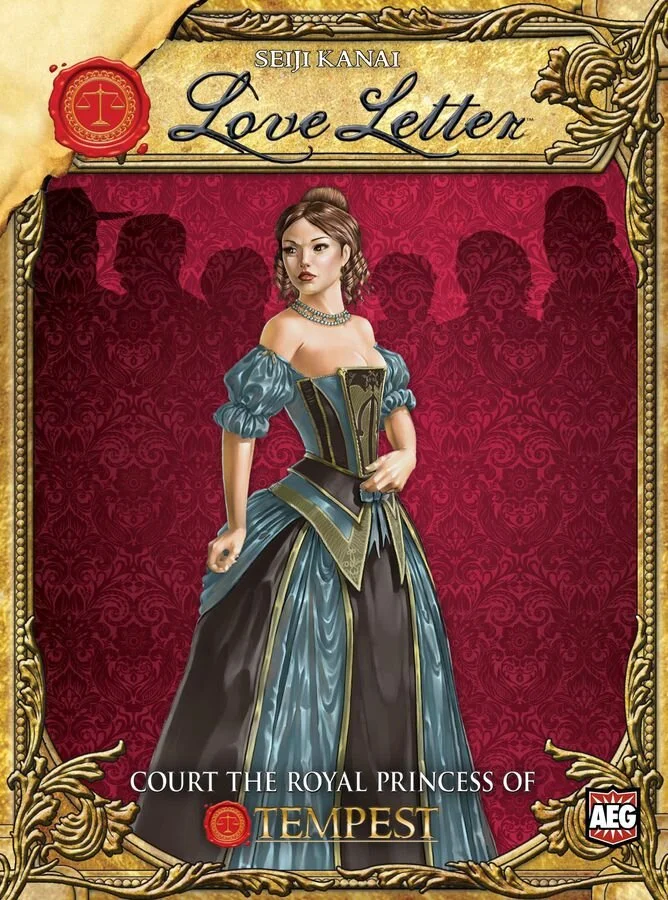
LOVE LETTER
Alderac Entertainment Group - 2012

picture from BoardGameGeek.com
It’s easy to think that the best board games come in the biggest boxes. The more components and the bigger the rule book then the more complex the game must be, which would require greater strategy and skill to play. That is not necessarily true, however. As the saying goes - big things come in little packages. Love Letter is about as small a package you can get when it comes to board games, the entire game fits in a small red velvet bag that comes with it. Its size is one of the major reasons I always include Love Letter on lists of my favorite games.
The goal of Love Letter is to deliver your expression of love to the Princess. You can’t always personally deliver it to her, so you must use people within her castle to deliver it for you. There are guards you can send, a baron, priest, prince, even the king. This is played out in the game using a set of fairly simple rules First, everyone starts with 1 card in their hand. On your turn, you draw 1 card. You then choose one of the 2 cards to play in front of you. The round ends when there are no cards left to draw or if all but 1 player have been eliminated from the round. All cards have a number and text on them that describes an action to take when the card is played, many of which result in eliminating a player from the round. For instance, the Guard card says that when played you may choose a player and name a card, if that player has said card then they are eliminated from the round. There’s also The Baron, when played, you and another player compare hands and the player with the lowest number is eliminated. There are cards that force players to trade hands, discard their hand and draw a new card, and a few other interesting actions.
I’m not a huge fan of social deduction games like The Resistance or Werewolf, but I do like the idea of having to use deduction as a game mechanic. Love Letter does this really well because it doesn’t rely on a player’s ability to act or lie, it relies on a player’s attentiveness to the game and knowledge of the cards. Any game that keeps players engaged on other player’s turns gets a lot of praise from me. Many games suffer from being basically a solitaire game with many people playing. Other games may suffer from runaway winner syndrome, where someone is clearly in line for victory. Love Letter is just the right mix of skill and luck that one person winning a few rounds in a row doesn’t necessarily give them an in-game advantage. In Monopoly the person with a lot of property early in the game is primed for victory. In Risk, the person with border and choke point control in certain areas has a leg up over everyone else. There have been many times in Love Letter where I’ve been had 3 out of the 4 round victories I needed to win but still ended up losing.
Love Letter is an excellent travel game as well. As I stated before, the game comes with a small velvet pouch in which all the game’s components fit. You could easily just throw it in your pocket and take it everywhere with you if you wanted. I’ve played with friends at bars, cafes, waiting for public transportation, the park, in the car, there are few places I can think of where you couldn’t play.
It’s a small, simple, and exciting little game. There are a lot of great games that come in massive boxes. Twilight Imperium is the biggest box I own and it’s a fantastic game, but it rarely hits the table because it takes literally 8 hours to finish. The box for Gloomhaven is absolutely massive, and it’s a great game, but it’s also often over $100. It’s true what I said before, the bigger the box the more components you get, the more rules to remember, but also, the deeper your pockets need to be. Love Letter fits in your pocket, doesn’t have many rules or components, but has plenty of strategy and is only about $10. It’s arguably the biggest bang for your buck because there’s almost no restrictions for when, where, and who can play. There’s no reason to not have it as part of your collection.
10 Board Games in 10 Days - Day 7 - Formula D
Formula 1 is the fastest motorsport in the world. Drivers need to be physically capable of experiencing drastic changes in G forces while maintaining the mental awareness that comes along with driving at insane speeds. So how in the world do you make a game that accurately represents the feeling of driving an F1 car?
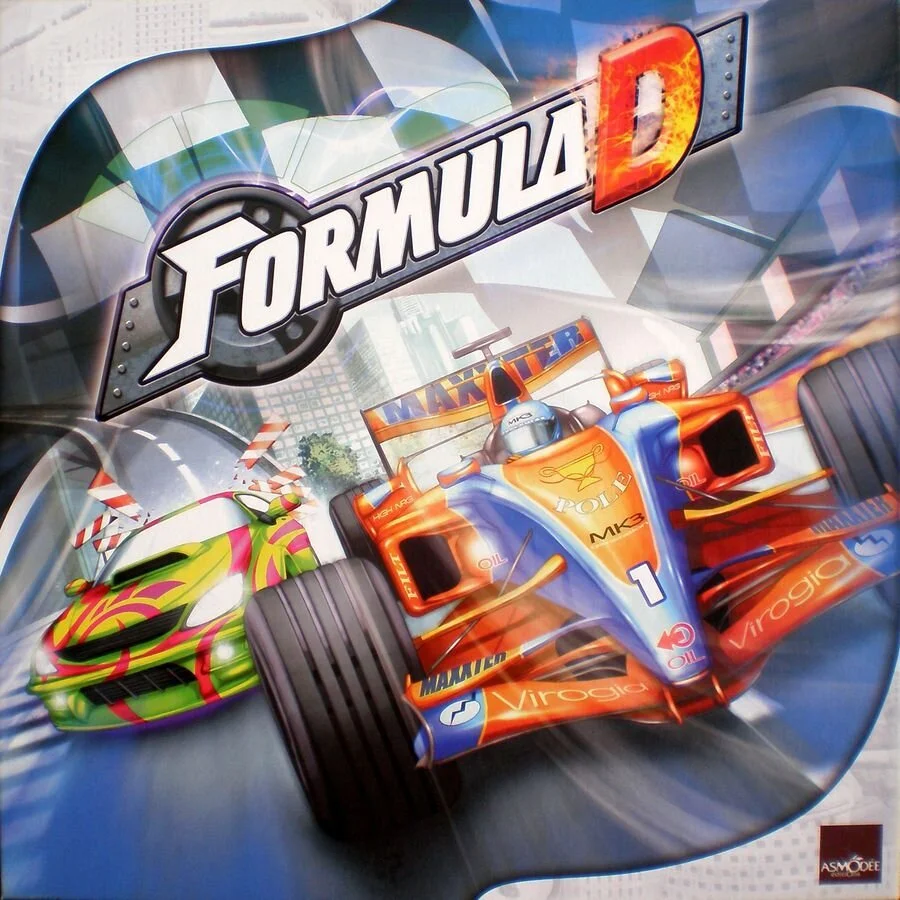
FORMULA D
Asmodee - 2008

picture from BoardGameGeek.com
Formula 1 is the fastest motorsport in the world. Drivers need to be physically capable of experiencing drastic changes in G forces while maintaining the mental awareness that comes along with driving at insane speeds. Dexterity, endurance, reaction time, no one attribute trumps another, all are important when it comes to Formula 1. One wrong move could mean the difference between a podium finish and last place or even death. Board games, on the other hand, are not life and death. “Fast” is a word that would probably never be used to describe anything when it comes to board games. Dexterity could come in handy but really board games are pretty accessible to people with disabilities, so it’s really not all that important. Endurance? Games like Twilight Imperium can be 6-10 hours long so endurance is definitely important but no one would say it’s the same as driving an F1 car. So how in the world do you make a game that accurately represents the feeling of driving an F1 car? Well, somehow, Formula D comes kinda close!
Formula D is one of those games that I bring to a game night and immediately draws attention. The rules for a race or simple, first to cross the finish line wins, and most people want to see how that works in a board game. Once I open the box and people see the little gear box and the cars there’s a good chance we’re playing right then and there. The mechanics are simple and familiar enough to pick up in the first game but complex enough to warrant coming back to. First, each person selects a car. They then collect their gear box. This is how you keep track of your car’s damage and which gear your car is in. After determining the starting positions, it’s time to race. Everyone starts in first gear, as you do when you’re driving. Each gear has a specific die associated with it. In first gear you have a 4 sided die but the only numbers on it are 1 and 2. You roll the die and move that number of spaces. At the start of your next turn you can choose to shift up or shift down. When you shift up from 1st to 2nd gear the die changes to a 6 sided die with values of 2, 3 and 4 printed on its sides. When you shift from 2nd to 3rd gear you now are allowed to use the 8 sided die with values 4, 5, 6, 7, and 8 printed on the side. You could potentially shift all the way up to 6th gear that is a whopper, a 30 sided die with 21-30 on each side.
When I’m teaching new people the rules the first question is always, “Why wouldn’t I just try to get up to 6th gear and blast all the way to the end? Why would I ever want to shift down?” Each corner in the track is marked with a red outline and a number. Your car is required to end its turn within the red outline at least the number of times as noted on the board. If you’re feeling dangerous you can blast right through a corner without stopping but if you end your turn too far outside of the corner, something like 4 spaces beyond the corner, you could potentially crash and burn. If the corner requires you to stop more than once and you don’t stop at all then you definitely crash and burn. In order to win you need to plan carefully, be mindful of the other cars in the race, and pick your spots where you put the pedal to the metal. It honestly does a really great job of recreating the sensation of being in a race.
Unfortunately, Formula D suffers from being an excruciatingly long game. The excitement is lost when you enter the late stages of the game and it feels like it’s just dragging its feet and taking forever. The problem stems from players counting out spaces before rolling to gauge the risk/reward of rolling the bigger die. “What happens if I try to go with 4th gear… 1, 2, 3, 4… no that won’t work. What about 3rd gear… 1, 2, 3, 4…” If you have a full compliment of 10 players this can cause the game to drag on for hours. If you’re playing with two or three people it’s not a big deal if all three are trying to take their time to find the optimal move but beyond that it can really kill the atmosphere of being in an intense race.
To adjust for this my friend and I came up with a house rule. When it comes to your turn you have only a few seconds to decide on your gear and roll. This keeps everyone focused on the game. They are forced to mentally calculate the optimal move while watching where the other cars end up. This, I believe, is how you achieve even a fraction of the pressure real F1 drivers feel when racing. I’ve done this method in a 7 player game with great success. The game still takes a bit of time to complete but with everyone locked in and rolling often you don’t feel like it takes forever.
Since I often play with new people it’s rare that we play with the full rule set. Each gear box has two sides, one is basic damage and the other side has damage tracks for specific parts. There are rules for weather, hazards on the track, and there are rules for racing more than one lap and utilizing the pit stop. On the opposite side of the board there’s a street racing map that has a whole additional rule book where drivers have special abilities. I’ve barely scratched the surface of the game and I’ve owned it for years. The basic rules are still so good that we haven’t really felt the need to spice things up.
It’s a big box, it draws the eye, but an even bigger draw is when you open the thing and dump out all the little cars. The track map is gorgeous to look at and is easy to read. The rules make sense for what actions you’re performing so players feel comfortable after the first corner. Because of the accessibility it’s often in my bag when going to see friends. The box is dinged up from travel but I think that’s the ultimate sign of a good game. A game with a brand new looking box probably doesn’t get much play, but a game with a box that looks like its been through war is one that hits the table frequently. If you don’t have one of those on your shelf, maybe you should take a look at getting a copy of Formula D.

10 Board Games in 10 Days - Day 6 - Letters from Whitechapel
Each round starts off with a murder, which surprisingly maintains a bit of historical accuracy. Jack the Ripper committed at least 5 murders and the Jack player attempts to do the same in the approximate locations as the real Jack. It’s pretty morbid now that I think about it.
LETTERS FROM WHITECHAPEL
Fantasy Flight Games - 2011

picture from BoardGameGeek.com
Sometimes there are games where the theme feels tacked on. You could easily change the theme and the game would feel no different. Many Euro style games suffer from this. Agricola doesn’t really feel like you’re farming. You could change it to city planning or creating an airline empire or coin collecting and the effects of the game wouldn’t be altered much. Then there are games like Letters from Whitechapel where the theme and mechanics are so perfectly married that if you were to change even the slightest detail the game just wouldn’t be the same.
Letters from Whitechapel is “one versus many” style game. Set in London in the late 1880’s, one to five players control the London police force and one player controls the infamous Jack the Ripper. “Controls” is a funny word to use because there actually is no piece for Jack. This is the most interesting concept about the game, hidden player movement. While the police force has pawns they move around the board and tokens to place in an attempt to track Jack, the Jack player makes notes on a piece of paper marking Jack’s current location. The board is a depiction of the Whitechapel district of London, the primary location of Jack the Ripper’s murders. The map is marked with white circles containing numbers connected with dotted lines. Between the numbered circles are black squares. Jack moves around the board by marking a piece of paper on which circled number their invisible pawn sits while the police force physically move their pawns to the black squares. From the squares, the police may investigate the white circle locations to try to either catch Jack the Ripper or determine which way he may have gone.
As you can imagine, it is an intense game of cat and mouse. Each round starts off with a murder, which surprisingly maintains a bit of historical accuracy. Jack the Ripper committed at least 5 murders and the Jack player attempts to do the same in the approximate locations as the real Jack. It’s pretty morbid now that I think about it. As time goes on, the police search gets more intense as they get closer and closer to Jack. Jack isn’t without a few tricks up his sleeve to elude police, however. Despite these tricks, the police, if they keep their wits about them, are never too far behind Jack. There have been very few occasions where the game hasn’t produced excitement.
My favorite memory from playing Letters from Whitechapel has to be the time my friend Dave Caswell came down from Connecticut specifically to spend the night playing the game. Joe Donnelly was there, of course, as he was my trusty board game sidekick for many years. It was a hot Summer night but we had a fridge full of cold beers so we opted to play at the kitchen table for easy access. We turned off all the lights except for a desk lamp pointed right at the board and it created some amazing mood lighting. Fortunately, there aren’t a lot of tiny pieces or cards with small print, so ample lighting isn’t really required. We spent probably 6 hours playing, rotating roles each game, seeing who was best at getting away with murder. I remember at one point, while I was acting as Jack, we took a break between rounds to just stand up and move around for a bit. Dave, still fully in character as a London detective, said “Joe, we have a murderer on our streets. He’s still out there and he has to be stopped,” punctuated with an open palm smack of the wall.
Coincidentally, at the time of this writing, that night was exactly 1 week and 7 years ago. When I first started this 10 Board Games in 10 Days project, I had intended it to just be blog posts about my favorite games. Maybe a brief description of the rules and why I like them so much. 6 days in to it, it’s been a serious journey down memory lane and has turned in to a sort of memoir. I think that’s the power of board games. Each game is an event. In a world that is controlled by technology, which I am not against at all, having a reason to get together and mess around with some analog games is an excellent break from the screen. The focus shifts from the tech to being present with each other. Video games are great for keeping in touch over distance, but my memories of amazing video game moments are few and far between. If nothing else, this blog series is proof that board games create excellent memories, more often than not.
What is this?
I am a freelance photographer and this blog is about my life as such. Sometimes I just need to vent. Sometimes I need to write down my thoughts to remind myself how I should be working. Other times I might just want to write about how I love my dog.
Why is this?
I believe it's important to get your thoughts out of your head sometimes. Some people write a journal for their own safe keeping. Other see therapists. I'm going to share my thoughts with the public. Feel free to communicate with me!