
10 Board Games in 10 Days - Day 2 - Flash Point: Fire Rescue
Flash Point: Fire Rescue isn’t my first experience with a purely cooperative game but it is definitely the one I’ve played the most.
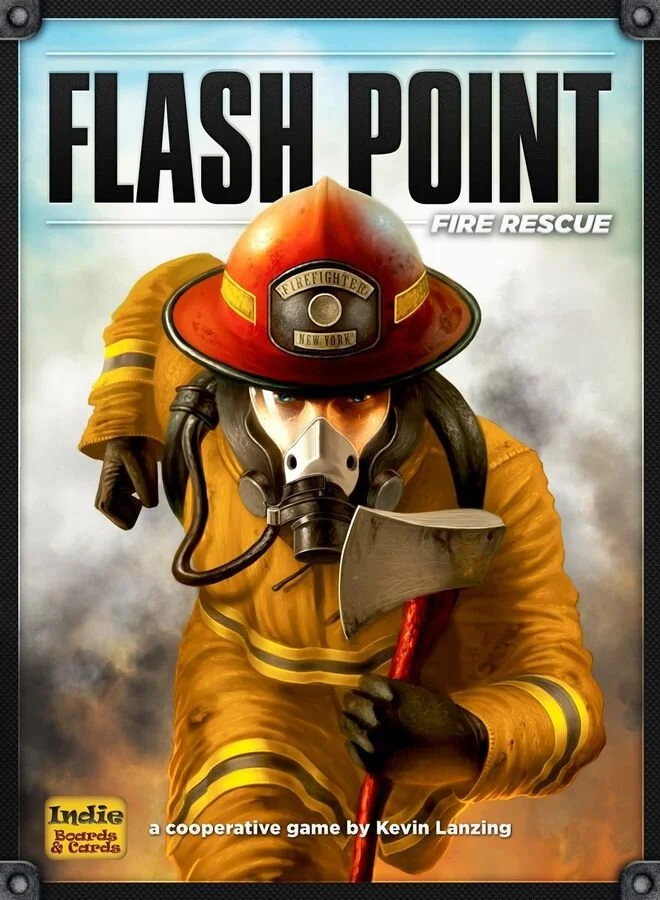
FLASH POINT: FIRE RESCUE
Indie Boards & Cards - 2011

picture from BoardGameGeek.com
Flash Point: Fire Rescue is a purely cooperative board game. There’s no backstabbing, no individual winners, no points tallied at the end. You either win as a team or fail as a team. It’s not the first board game designed this way but it’s the one I’ve played the most. My first experience with cooperative board games was with Pandemic, which plays similarly to Flash Point.
Pandemic pits the players, as you can imagine, against a global pandemic. Actually, there are 4 viruses or diseases spreading around the world. Each player takes control of a different specialist. Maybe you excel at helping other players move around the board or maybe you can share information more easily, that sort of thing. A player takes their turn using action points to move and hopefully remove virus markers from the board. When they are finished it’s the board’s turn to act. You draw cards from a deck which tell you were to place new virus cubes. There are also event cards which may cause additional cubes to be places or maybe no cubes at all! If you get too many cubes in one region you have an outbreak, which causes the disease to spread faster and wider. if you’re especially unlucky you could chain together outbreaks and then you’re in serious trouble. The players win if they are able to eradicate all 4 viruses. The game wins if you run out of cubes or if the deck of cards depletes.
Flash Point operates in a very similar fashion. Each player assumes the role of a fire fighter. There are two modes of play you can use - one where everyone is just a generic fire fighter with no special abilities and in the other everyone has a unique role with specific actions they can take. I prefer the latter because I think giving a player special actions makes them feel important and can help keep their interest in the game. The former may cause one player to assume control of the game in an attempt to optimize play.
This leads me to my biggest issue with cooperative games, it’s very easy for an experienced player to push others aside and take command. Everyone wants to win and to win often requires performing the optimal move, so I completely understand why someone might try to tell others how to take their turn. However; player autonomy is important. Without it why play with your friends at all? Discussing moves as a team is encouraged, of course, but one player taking control is a problem.
Between these two games I’ve always preferred Flash Point because it was subject I could wrap my head around. I didn’t know what it was like to be part of a pandemic but I could very easily imagine being in a house fire. Of course now I know exactly what being in a pandemic feels like but even still I think I prefer Flash Point mostly for reasons I would normally look over in other games. Pandemic uses cubes to represent the various diseases whereas Flash Point uses tokens with graphics and miniatures. Don’t get me wrong, I love games with cubes. Many games I’m going to talk about in future posts are mostly just cubes you move around. Both games have very similar gameplay so really the pieces are the tie breaker and, lets face it, moving around a little fireman and flipping fire tokens is more fun to look at than a pawn and some cubes.
Flash Point: Fire Rescue is often game I’ll break out for people who haven’t played a modern board game outside of Settlers of Catan. People love the cooperative aspect, it’s so different from the board games we grew up with. Much like my biggest reason for loving Betrayal at House on the HIll, Flash Point: Fire Rescue creates an amazing narrative in your mind. It’s easy to imagine you’re a fire fighter actually running in to the building and doing heroic deeds. Or being so brazen to smash down a wall only to realize later that had you just gone around and used the door maybe the building would still be standing. I have so many fun memories with this game it’s impossible to choose just one, which is all you can ask for in a board game.
10 Boards Games in 10 Days - Day 1 - Betrayal at House on the Hill
Back in 2012 I played a board game with my friend Joe.
At the start of this year I asked if this year would be the year of the portrait. Do you know what portraiture requires? Being near people. Unfortunately for me, and the rest of the world, Covid-19 rolled around and being around people is not a good look, so my experimentation with portraiture has been put on hiatus. NYC is opening up again, but a second wave of cases certainly isn’t out of the question so I’ve decided to wait it out until the virus is contained in some way.
With this time I’ve decided to do some writing about some of my other interests. It’s no secret that I’m a massive nerd. If you scroll far enough in my Instagram account (@sd_conrad) you will find lots of cell phone pictures of board games. On top of that, there’s a D20 in my logo that I use on business cards and on my website. I thought it might be fun to write about games that I enjoy or have inspired me in some way. I also work best with deadlines, so why not write about 1 game a day for 10 days? Without further ado, lets get started.
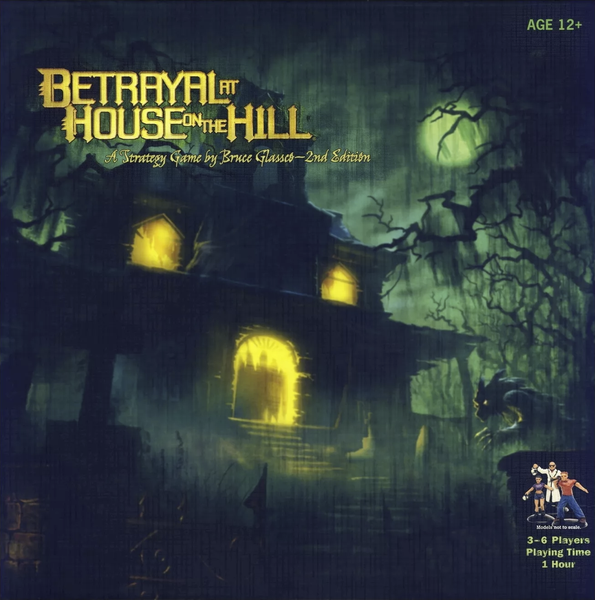
BETRAYAL AT HOUSE ON THE HILL
Avalon Hill - 2004

picture from BoardGameGeek.com
Back in 2012 or so I was in a funk. I hated my job, I wasn’t doing anything creative, I didn’t have any hobbies, I was just kinda coasting with no direction. In my search for something to sink my teeth into I discovered the YouTube series Tabletop, which had debuted earlier in the year. After watching a few episodes I thought board games might be something I could enjoy. A quick search revealed that my local game store, Twenty Sided Store in Brooklyn, had a weekly board game night where they taught games. I recruited my buddy Joe Donnelly, who is always up for something new, and we were off. The game of the night happened to be Betrayal at House on the Hill.
The game had me hooked immediately, I had never seen anything like it. Most board games I knew were the type where you pull out a square piece of cardboard, unfold it, place your piece at the start, and you roll some dice to move. This couldn’t be any more different. You still pick your piece but each piece has unique properties, unlike a game like Monopoly where the piece you choose is arbitrary. In Betrayal, choosing your piece has consequences. There’s also no board, at least not your traditional board.
I should back up a bit because in order to understand the game’s mechanics you should know the theme of the game. Based on the name and the box art it should be easy to deduce that the game is a horror themed adventure. You and up to 5 other players take control of different characters who are drawn to this spooky house on the hill for one reason or another. Each character fits your classic horror story archetype - there’s the jock, the beauty, the young boy, the little girl, the old man, and the mystical woman. When you select your character you get a character card with your stats and a unique pawn. Additionally, each archetype has two sides with two different sets of stats. For instance, the jock can either be Darrin “Flash” Williams or Ox Bellows. One is super speedy, the other is super strong, neither have much in the way of intelligence. You can be Father Rhinehardt or Professor Longfellow, Rhinehardt having greater resistance to losing his mind and Professor Longfellow a greater set of general knowledge, but neither are physical specimens like Flash or Ox. These stats are important for the scenarios that happen later in the game, but you don’t know which stats will be important until it’s too late to do anything about it.
When our teacher was setting up the game the first thing I noticed was how the “board” is set up. Instead of the cardboard being unfolded and presented before us, a small strip of cardboard was placed on the table with the artwork of a large entryway for a mansion. This is where all the players start. There are a total of four doors along the hallway and a set of stairs going up to the second level, which is represented by square piece of cardboard set off to the side. We also know there’s a basement indicated with a separate piece also set to the side but we don’t know where those stairs are. On your turn you can move a set number of squares as indicated by your character’s “speed” attribute. So while Flash can dart around the mansion moving up to 6 squares as he sees fit, Father Rhinehardt ambles along moving only up to 3 squares. During your turn you may explore what’s on the other side of an unopened door. When you do, your movement ends and you pull a tile off the stack of room tiles and align the door symbols as best you can. This modular board means you will never see the same layout twice. This concept absolutely blew me away when I saw it.
At the start of the game there is no clear objective, you’re just exploring. Each room will have either an Event, an Item, or an Omen. Events can be good or bad, items can be good or bad, omens can be good or bad, it’s pure chaos from the start. The major caveat is if you draw an Omen card you must perform a die roll which might trigger the next phase of the game - The Haunt.
The Haunt is where the game turns itself upside down. There are 50 different potential haunts so you could play this game many times before seeing the same haunt twice. The Haunt reveals the objective of the game and sets win conditions for all the players. There are too many to go through and each are different enough to be exciting to experience for the first or even the second time.
Back in 2012, Joe and I were sitting in Twenty Sided Store, we’re both deep in to the role play aspect of the game. Joe was Ox and was doing his best 80s horror movie meat head. I was Zoe Ingstrom, an 8 year old girl obsessed with her dolly. We had 3 strangers playing with us who were equally in to their characters. Whenever we had to draw a card we did our best to make it as campy and ridiculous as possible. At the time we didn’t know a haunt was even going to happen. Our teacher hadn’t told us why we were rolling dice each time we pulled an Omen card and he told us to just do what our instincts said. Once the haunt began one of us was revealed to be the villain. This is where the game gets its name, one of you will betray the rest when the haunt begins.
Our teacher gave us the book about haunts and helped us figure out which haunt we were on and let us loose to figure out our win conditions. He then brought the betrayer outside with their OWN book to determine their own win conditions. Now we’ve got a game! Before this it was just madness, now we’re in it to win it.
I don’t remember the exact scenario we had but I have vivid memory of the end of the game. The betrayer had a Frankenstein’s Monster type of thing on their side that automatically attacked the closest target. We had these torches we could use to throw at the monster to slow it down and we knew in order to kill it we had to throw it off the ledge from 1 of 3 different ledges we knew about in the game. The monster had already killed a number of us and it was down to just me and Joe.
We lured the monster to a set of stairs that lead up to a balcony. I, knowing it could only do 1 move and 1 attack on its turn, sacrificed myself for the greater good and moved myself to the same room as the monster. On its turn the monster attacked me, killing me instantly, and made its way up to the balcony to attack Joe on its next turn. Joe, as Ox, had one shot to shove this horrible monster to its death. I swear the dice flew out of his hands in slow motion, all of us with our fingers crossed. The person playing the betrayer had no idea his monster was in peril when he went up there. He didn’t know our win condition was to push his monster from a great height, he didn’t even know it was an option. He sat there watching the dice as intently as the rest of us, stunned that he allowed this to happen. Ox is a strong guy and this is a strength roll so he was rolling all the dice available. I don’t remember what he needed to roll but I remember leaping out of my chair and yelling. He had done it. Joe raised both of his arms and shouted, the rest of our team high fiving, the betrayer laughing and clapping, and our teacher giggling to himself standing over us. The rest of the store had been pretty quiet up until that point but suddenly people were coming over asking what happened. We probably talked about the events of the game longer than it took for the game to play out. I still talk about that session to this day.
And that’s the point of the game. It’s not the best game I’ve ever played, it’s not even my favorite game. The game isn’t about who has the best strategy or who can outsmart the other players the best, it’s about the stories it generates. I’ll be honest, sometimes the random aspects sets up a scenario that just doesn’t work well. I’ve had a haunt end on the very first turn it starts because we happened to have everything we needed to win. That really sucks but that’s just how it goes sometimes, the game is far from perfect. It doesn’t need to be perfect, it’s fine just the way it is with all its flaws. If you and your friends are able to put yourselves in that house as those characters then each game will be fun regardless and more often than not you’ll end up with a great story you’ll remember for a long time.
Even after the rest of the store went back to their own thing, Joe and I talked with the other players about the game for a good while. Joe and I argued over who was going to buy it that night. Joe won. That night turned in to a cherished memory immediately and Betrayal at House on the Hill caused it. Even though it might produce the odd bad game every once in a while, it will always have a place on my shelf because of that one night in 2012.
2020 - The Year of the Portrait... maybe...
At the end of 2019 I was feeling pretty defeated. I had been laid off from my job as a product photographer and creatively I was in a serious funk. No form of photography interested me. I’d sit in my apartment trying to think of a project and nothing I came up with really spoke to me. Urban wildlife? I’ve done that. Look at my Instagram and you’ll see plenty of pigeons, the occasional hawk, squirrels, a dead rat… I’m not convinced people are too interested in seeing that sort of thing at this point. Every other idea I had I knew there were other people doing it and were successful. Photographing and speaking to random people on the street - People of New York already exists and I wasn’t too interested in speaking with strangers. Photographing random dogs on the street - The Dogist is doing that and I already photograph plenty of dogs. Everything else I thought of required a studio, which I don’t have. That mindset changed on December 25th of 2019.
For Christmas in 2019 I accompanied my girlfriend to her family’s home in DC. It was suggested to me that I create an Amazon wishlist of small items I might want for Christmas. I haven’t asked for anything for Christmas in almost 20 years so I had no idea what to do. I certainly couldn’t ask for a 1DX Mark III or an 800mm lens, which are items I legitimately want but it might be a little rude asking for almost $20,000 worth of items. So I started browsing the photography department to see if there were fun little accessories I could use. I came across a book called Studio Anywhere by Nick Fancher and I read a quick preview. It seemed pretty neat, the concept was that instead of renting or owning a studio you have a little portable studio that you can travel with. Surely I would need to buy more equipment I couldn’t afford but it might be an interesting read anyway. Fast forward to Christmas and Clare’s parents are kind enough to get the book for me and in the evening I started reading. The introduction might as well been my autobiography.
The book opens talking about how we all wish we had ideal conditions. A 5,000 square foot studio in NYC, top of the line equipment, more assistants than you know what to do with, the works. He goes on to describe the reality which perfectly mirrored my exact situation. I’ve got an old camera body I bought used and two high quality lenses that took forever to save up for, along with a few other very specific descriptors that apply to my life. He later shares a list of equipment he used for all the photographs found in the book and it mostly matched my own equipment, save for a few affordable additions. I immediately flipped through the whole book looking at the photos thing “No way, he’s lying.” To my surprise he shared a few behind the scenes photos as well. My understanding of what could be done immediately changed. I don’t need a studio, I don’t need expensive equipment. Like Tim Gunn says, I just need to make it work.
I’ve done portraits before but it was never something I advertised. When someone approached me looking for portraits I’d temper expectations, knowing I’d have to deal with conditions far from ideal. There was only one time in the last few years where I had access to lights and it was when I worked my friend Alex Fischer to photograph lawyers at a firm.



Looking back, there are a lot of things I’d change about these photos and I’d edit them completely differently. I think the depth of field is far too shallow and the client’s skin may be affected by the wall color just a bit much. They’re still serviceable photos and the client still uses these pictures years later.
Most of the time when I was asked to photograph portraits I requested we do it outside. While light indoors is easier to control, the lighting indoors is often unflattering and too dim to get the quality I want. There was one day when I was asked to photograph a series of young professionals who were in the city for a conference. We had access to Bloomingdale’s for some reason and I was asked we photograph the portraits inside. I hated that idea but it’s what they wanted, it made no sense to me. I did what they asked, I had no option anyway, it was raining outside. Then suddenly the rain stopped and the sun came out. I gathered my subjects and said “Round 2, follow me outside” and I redid the portraits, knowing the wetness outside would create some really great soft light.


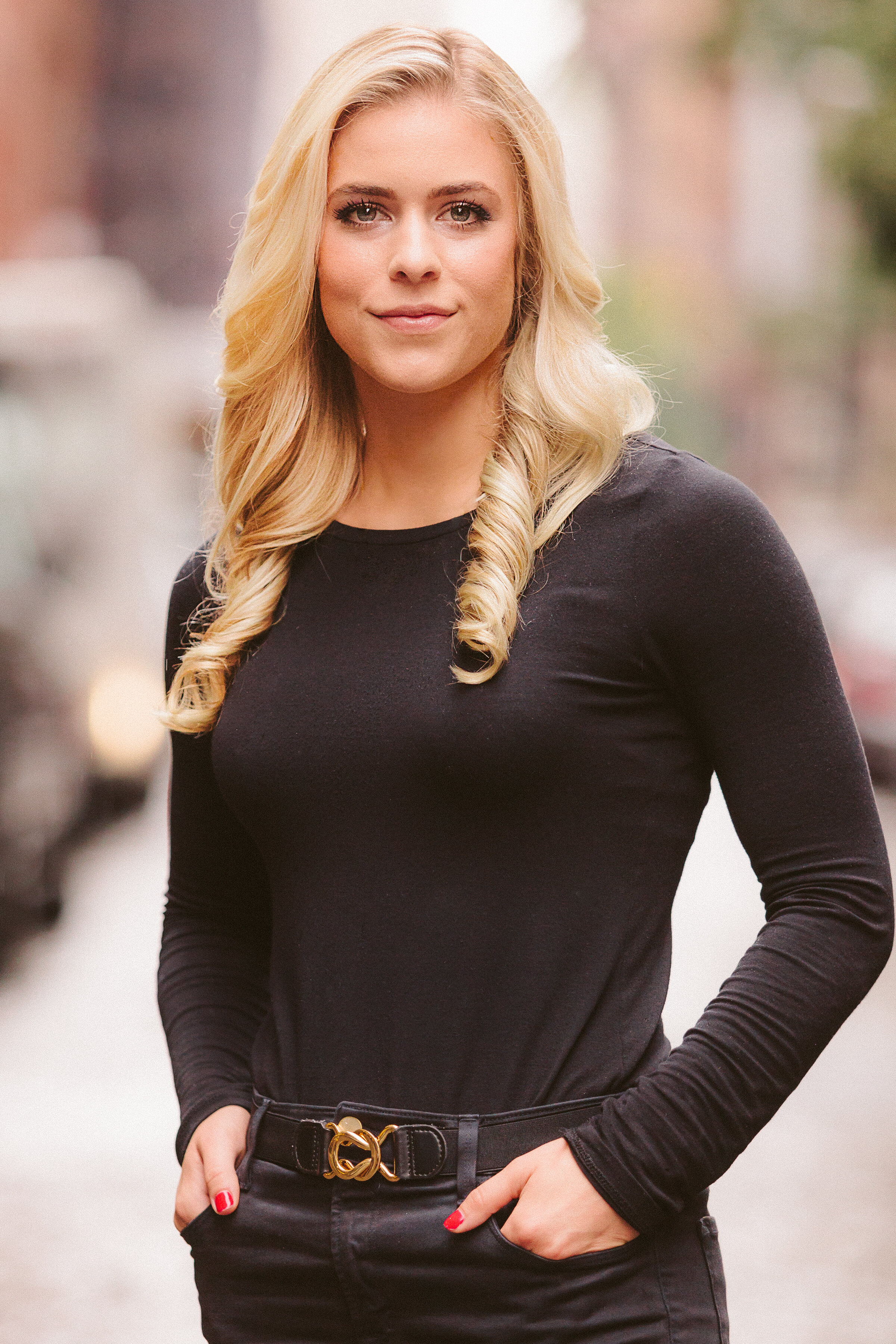
The results speak for themselves. The client liked these photos much more than the Bloomingdale’s photos and I didn’t even add those photos to my portfolio, they’ve been lost to time. From then on all I but refused to do interior portraits unless I could also bring the client outside for what I considered to be better photos.
When I started reading Studio Anywhere and realized I was just a few items away from matching Nick Francher’s exact gear load out. I did a bit of shopping and found items that suited my photographic style and pulled the trigger on attempting to make a serious effort in photographing portraits. My first test images were with my girlfriend, Clare.

Clare O’Sullivan - @ccosul on Instagram
This photograph was taken in haste, I hurried through setting up my new gear, throwing up a few yards of black velvet on the wall, and asked Clare to pose for me. I took maybe 6 pictures before I dismissed her and checked out the photos in Lightroom. I honestly couldn’t believe it was taken in my living room. It wasn’t perfect but it was far better than I anticipated. I knew I had to do more but I had no subjects. So I tried myself.

My large head
I look a mess and immediately went and trimmed my beard after this photo but I was surprised once again with the quality. Desperate for more subjects I began messaging friends “Hey, let me photograph you.” “Do you have time on a lunch break or anything?” “Yo! I know we haven’t talked in a while but let me take your picture!”

Camille Harris - jazz musician, comedian, entertainer
With this photo I thought the background didn’t really match the emotion of the subject. It’s white leaning toward grey, it didn’t really work for me but my options were either black or white. Then I realized I could probably Photoshop the background to a more appropriate color…

Then I thought “I wonder if I can get more expressive with the lights themselves?” I have a background in lighting, I’m sure I can make something happen.

Stephanie Fagan - actor, podcaster (That’s The Spirit!)
My mind as been moving at a million miles an hour since January. All I want to do is sit people down in front of me, play with my lights, and take pictures. I’m finally having fun again. Last year I did maybe 10 portraits, tops. This year, I hope to do 100, 200, 300, all I can think about is portraits. How to get more clients, different lighting set ups, how I can further improve my editing. And honestly, it’s all thanks to this little ~200 page book.

My most recent portrait for a professional’s profile
If you are looking for a portrait photographer then you can look no further. Email me today at contact@sdconrad.com for rates and to book your appointment. The studio comes to you!
What is this?
I am a freelance photographer and this blog is about my life as such. Sometimes I just need to vent. Sometimes I need to write down my thoughts to remind myself how I should be working. Other times I might just want to write about how I love my dog.
Why is this?
I believe it's important to get your thoughts out of your head sometimes. Some people write a journal for their own safe keeping. Other see therapists. I'm going to share my thoughts with the public. Feel free to communicate with me!