
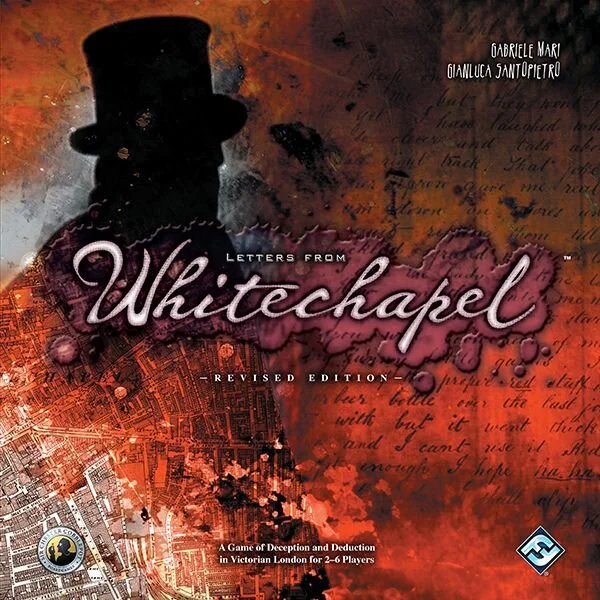
10 Board Games in 10 Days - Day 6 - Letters from Whitechapel
Each round starts off with a murder, which surprisingly maintains a bit of historical accuracy. Jack the Ripper committed at least 5 murders and the Jack player attempts to do the same in the approximate locations as the real Jack. It’s pretty morbid now that I think about it.
LETTERS FROM WHITECHAPEL
Fantasy Flight Games - 2011
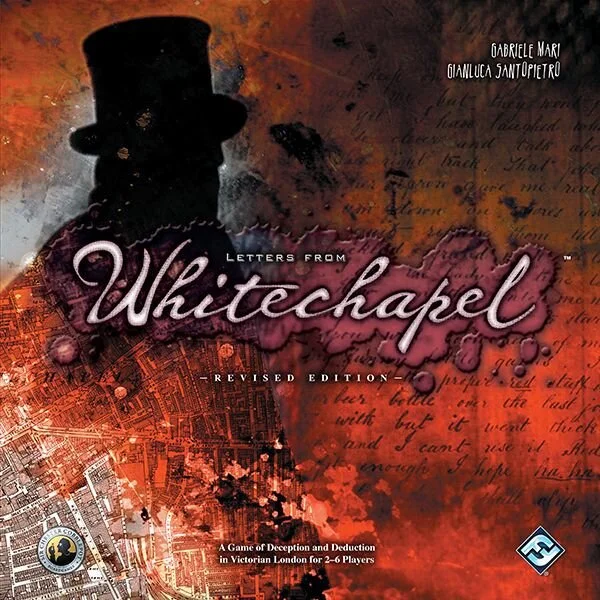
picture from BoardGameGeek.com
Sometimes there are games where the theme feels tacked on. You could easily change the theme and the game would feel no different. Many Euro style games suffer from this. Agricola doesn’t really feel like you’re farming. You could change it to city planning or creating an airline empire or coin collecting and the effects of the game wouldn’t be altered much. Then there are games like Letters from Whitechapel where the theme and mechanics are so perfectly married that if you were to change even the slightest detail the game just wouldn’t be the same.
Letters from Whitechapel is “one versus many” style game. Set in London in the late 1880’s, one to five players control the London police force and one player controls the infamous Jack the Ripper. “Controls” is a funny word to use because there actually is no piece for Jack. This is the most interesting concept about the game, hidden player movement. While the police force has pawns they move around the board and tokens to place in an attempt to track Jack, the Jack player makes notes on a piece of paper marking Jack’s current location. The board is a depiction of the Whitechapel district of London, the primary location of Jack the Ripper’s murders. The map is marked with white circles containing numbers connected with dotted lines. Between the numbered circles are black squares. Jack moves around the board by marking a piece of paper on which circled number their invisible pawn sits while the police force physically move their pawns to the black squares. From the squares, the police may investigate the white circle locations to try to either catch Jack the Ripper or determine which way he may have gone.
As you can imagine, it is an intense game of cat and mouse. Each round starts off with a murder, which surprisingly maintains a bit of historical accuracy. Jack the Ripper committed at least 5 murders and the Jack player attempts to do the same in the approximate locations as the real Jack. It’s pretty morbid now that I think about it. As time goes on, the police search gets more intense as they get closer and closer to Jack. Jack isn’t without a few tricks up his sleeve to elude police, however. Despite these tricks, the police, if they keep their wits about them, are never too far behind Jack. There have been very few occasions where the game hasn’t produced excitement.
My favorite memory from playing Letters from Whitechapel has to be the time my friend Dave Caswell came down from Connecticut specifically to spend the night playing the game. Joe Donnelly was there, of course, as he was my trusty board game sidekick for many years. It was a hot Summer night but we had a fridge full of cold beers so we opted to play at the kitchen table for easy access. We turned off all the lights except for a desk lamp pointed right at the board and it created some amazing mood lighting. Fortunately, there aren’t a lot of tiny pieces or cards with small print, so ample lighting isn’t really required. We spent probably 6 hours playing, rotating roles each game, seeing who was best at getting away with murder. I remember at one point, while I was acting as Jack, we took a break between rounds to just stand up and move around for a bit. Dave, still fully in character as a London detective, said “Joe, we have a murderer on our streets. He’s still out there and he has to be stopped,” punctuated with an open palm smack of the wall.
Coincidentally, at the time of this writing, that night was exactly 1 week and 7 years ago. When I first started this 10 Board Games in 10 Days project, I had intended it to just be blog posts about my favorite games. Maybe a brief description of the rules and why I like them so much. 6 days in to it, it’s been a serious journey down memory lane and has turned in to a sort of memoir. I think that’s the power of board games. Each game is an event. In a world that is controlled by technology, which I am not against at all, having a reason to get together and mess around with some analog games is an excellent break from the screen. The focus shifts from the tech to being present with each other. Video games are great for keeping in touch over distance, but my memories of amazing video game moments are few and far between. If nothing else, this blog series is proof that board games create excellent memories, more often than not.
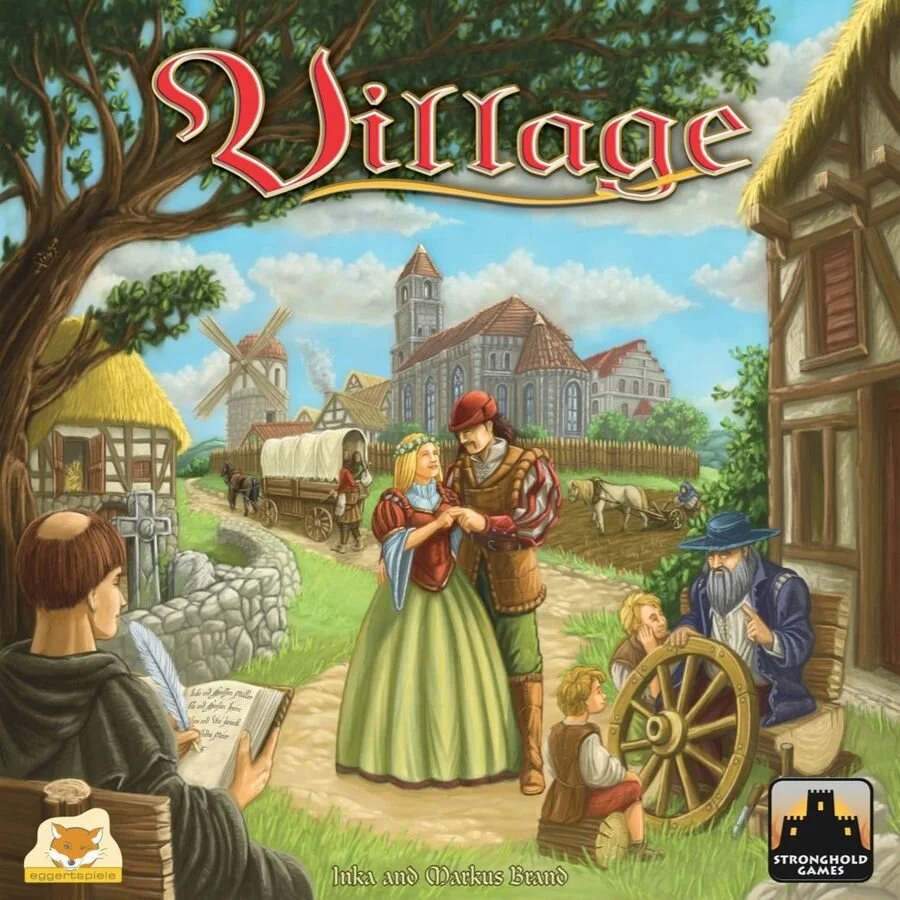
10 Board Games in 10 Days - Day 5 - Village
Village is a game that I absolutely love but have played only a few times and have never owned myself. I haven’t played it in years, but it’s still one I think about frequently.
VILLAGE
Stronghold Games - 2011

picture from BoardGameGeek.com
My friends Joe, Bryan, and John were my go-to crew for playing board games. It never took much convincing to get them to come over to try any new board game. Everything was great until both bars where Joe worked were shut down. With no job and no prospects for more work, Joe sought greener pastures out west in Los Angeles working for his friend’s entertainment company. Bryan also felt the call of the Golden State and left to join our friends in the world of film and television. John, also in work limbo, was often heading back to Massachusetts to pick up short term work from people he knew there when he could. Just like that, my board game group exploded. I love board games but, unlike video games, you need people physically around in order to enjoy them. Luckily for me, I happened to know some people who knew some people who were also in to board games. I was surprised to find we had many of the same tastes. I think on our first encounter we play Betrayal at House on the Hill, by this point it had become a classic in my mind. We also played Battlestar Galactica which is a great take on the secret identity social deduction types of games, which I normally dislike. They also introduced me to Village.
Village is a game that I absolutely love but have played only a few times and have never owned myself. It’s one of those games where when we do have a game night it’s always at the top of my list. Unfortunately, the folks who owned it moved thousands of miles away, so I haven’t played it in years, but it’s still one I think about frequently. Much like Agricola, it is a worker placement game, in a way. You have workers you place, yes, but most of the actions are acquired by taking cubes from the board. You then can spend cubes later to trade in for resources. The most interesting option is placing one of your family members on one of the actions and spending time, instead of resources, to obtain goods. Village is all about time and family generations and how they’re remembered.
I called Village a worker placement game, and it is, but only partly. Taking an action doesn’t require you to place a worker there, the action is drafted. How you pay for that action is where your workers come in to play. The central board is the village in which the player’s families ply their trade and sell their goods. On the central board, all of the actions are split up in to zones. There’s the craft zone, the trade zone, the town council, and a small map of neighboring towns. If you want to take one of the available actions you must take a cube from that zone. Want to get some grain? Take a cube from the silo. Want to build a wagon? Take a cube from the wainwright. There are also resources you must pay to gain these things but all actions are first initiated by taking a cube, if available. If no cube is available you cannot take the action. You can also place a family member in one of these zones to gain knowledge in that skill. So when you take a cube from the wainwright, you can place a family member there to train them. This way, when you take a cube from the wainwright in subsequent turns, instead of spending resources to gain a cart you can instead pay time.
Each player has a small board in front of them where they have their family members, resources, and influence cubes. Most importantly, there is a series of hour glasses around the edge of the board. Starting at the 12:00 position the hour glass is full. Continue clockwise and you will see your hour glass drains until it is depleted and resets back to full. When you reset your hour glass= enough time has passed for one of your family members to kick the bucket. You choose any of your family members, whether they be in a location on the central board or back at home, and they are removed from the game permanently. This isn’t necessarily a bad thing! If you decide your family member who has been training to be a wainwright should die then they are placed in the town chronicle. This is a great way to score points for the end of the game. There are limited spots in the chronicle so filling it up with your family may be your ultimate goal. Working your family to the bone quickly and filling up those pages isn’t a terrible strategy. If the chronicle is out of pages for tradespeople, for instance, your family member is instead interred in the church graveyard which, unfortunately, is unremarkable and not worth many, if any, points.
The death mechanic one of the most fascinating aspects of any game I’ve come across. I’m sure there are games with a similar mechanic, but the story within Village is what makes it special. When we played, we’d often come up with names and histories for our little meeples. When mass was called, we’d break out in to monk-like chanting. The town council was always filled with nasty politicians greedy for power. Running in to a rival family member on the roads outside of town was met with vitriol and expletives. So when one of those meeples died, so did the character. If that character didn’t make it in to the chronicle, you felt bad you couldn’t end their life sooner. It’s an odd sensation.
I think I may have played Village only 5 or 6 times but it left a lasting impression on me. Even now I was just looking to see how much it is online and wondered if I should make space for it on my shelf. Honestly; I should make space for it. Once this pandemic is under control maybe I’ll finally add it to my collection. It would be a shame if it never made it in to my own personal chronicle.
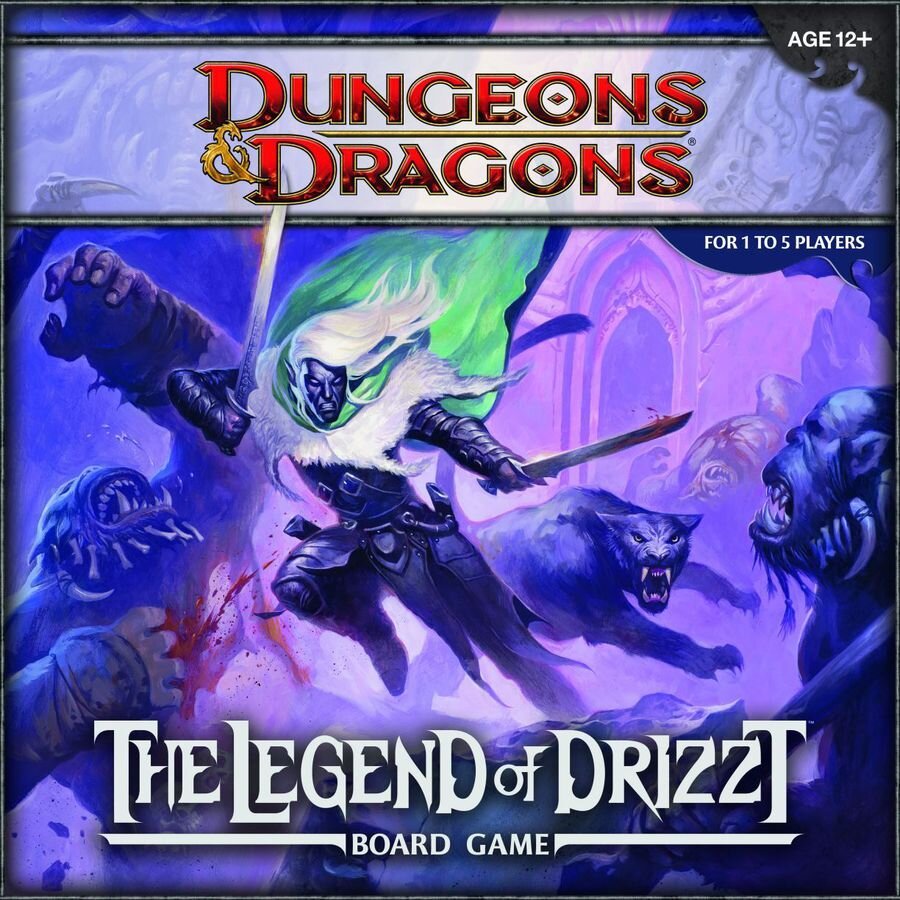
10 Board Games in 10 Days - Day 4 - The Legend of Drizzt
After reading a few of Drizzt’s adventures I required more Dungeons & Dragons in my life.
DUNGEONS & DRAGONS: THE LEGEND OF DRIZZT
Wizards of the Coast - 2011

picture from BoardGameGeek.com
Growing up, my brothers had all kinds of Dungeons & Dragons books. Not just rule books, but tons of novels from Forgotten Realms, Dragonlance, Ravenloft, Greyhawk, and probably others I can’t recall. I didn’t get around to playing Dungeons & Dragons until I was about 13 or so, but as a kid I would flip through the bestiary just to look at the artwork. I remember thinking Mind Flayers were rad as hell and when I saw a beholder I was like, “Oh, that’s the thing from Big Trouble in Little China!” When I was a teenager one of my brothers decided to set up a D&D session with me and some friends. It was mostly just a free-form improv session because we didn’t have any dice, no character sheets, we were just role-playing for the sake of it. I later dug out the rule books and created a character because I wanted to try an actual game but we never got it off the ground. I had an opportunity to play in college and I was able to recreate the character I had made when I was a teen. From there I was completely hooked but I hadn’t realized it, the seed sat dormant in my brain for years. I didn’t think about D&D much until I was about 30 when my other brother asked if I wanted to play. So, I recreated my character, again, and we played a few sessions. It was great! In my research for more ways to get D&D in my life I rediscovered the novels from my childhood and one book cover in particular stood out. That book was The Crystal Shard by R. A. Salvatore.

picture from Wikipedia
When I saw this book cover I had an immediate flashback to being about 7 years old and going through all of my brothers’ books. This one in particular stood out to me, the barbarian standing there ready to wreck stuff with his hammer, the dwarf nonchalantly leaning on his axe, and the elf using his senses to track whatever it is they’re after, I never knew because I never read it. Turns out these are incredibly popular characters created by an incredibly popular fantasy author, so picking up my own copy was as simple as going to The Strand and pulling it off the shelf. After 30 years I finally learned the story behind these characters. Wulfgar the barbarian, Bruenor Battlehammer the dwarf, and Drizzt Do’Urden the drow.
The story is a fish out of water tale for all involved. Wulfgar is a barbarian from the outskirts of society who is indentured to the dwarves in a region called Ten Towns after a failed barbarian attack. Bruenor, king of the dwarves of Mithral Hall, adopts Wulfgar, in a way, and constructs amazing weaponry for him. On top of that, he is best friends with Drizzt, a drow, who are usually enemies to the dwarves, and a halfling named Regis who uses magic to influence those around him, which is something dwarves typically condemn. There’s Catti-Brie, the adopted human daughter of Bruenor. Her father was killed by a goblin attack repelled by Clan Battlehammer. She was found by Bruenor in the rubble and taken to Mithral Hall to live with the dwarves. Regis is a halfling and not much is known about him before arriving in Ten Towns other than he’s from far in the south. He makes a decent living making scrimshaw trinkets and sits on the Ten Towns council. The reader knows Regis is a bit of a trickster, Drizzt and Bruenor know too but forgive him for it, and he uses these tricks for personal gain on a regular basis. Drizzt is a drow, a race of elves considered evil. Drow are feared for the cruelty and vengeful behavior. Their worship of Lolth is enough reason for most to fear the drow and keep them at a distance. Drizzt is different. He left the underdark, something unheard of to the drow, and attempts to make a life above ground.
I didn’t realize this until later but the fish out of water aspect of the book is probably what resonated with me the most. I went to college 1,300 miles away from home and after I graduated I moved to New York City. I didn’t feel comfortable at home, so I left. I didn’t feel comfortable where I went to college, so I left. Despite settling in NYC and living here for over a decade I’m not entirely sure if I even feel comfortable here. All of the characters in the book yearned for adventure. While they loved their homes and wanted to protect them they simultaneously didn’t feel as though they totally belonged. I think a lot of people feel this way but it wasn’t something I had thought about much until I finished the book.
After reading a few of Drizzt’s adventures I required more Dungeons & Dragons in my life. Board games as a hobby had recently become a part of my life so I wondered if there were board game alternatives to D&D. Sure enough, Wizards of the Coast were way ahead of me and had, at the time, three D&D board game adventures available. As luck would have it, there was even one based on the adventures of Drizzt Do’Urden and friends.
As usual, I bought the game and called Joe Donnelly to come play. This is the first time, I think, where we were setting up the game and whipped through the rules because there were mechanics we were already familiar with. Primarily the modular board, which works similarly to Betrayal at House on the Hill. The board isn’t so much a board as it is just a stack of tiles. When you start the adventure you place a specific starting tile on the table and place your characters on it. Then find your destination tile and grab a number of random room tiles as determined by your chosen scenario. You then grab 2 of the random room tiles and shuffle in your destination tile, then place those 3 tiles at the bottom of the tile deck. This means you’ll know when you’re close to your destination but you aren’t exactly sure just how much farther you need to go. This method actually does a great job of recreating the dungeon crawl experience. The modular board means even if you run the same scenario multiple times the map and the order of encounters will never be the same. There are also many characters to choose from. Of course there are the characters mentioned above but also a few side characters and you can even play as some of Drizzt’s most famous rivals, all with different stats and abilities.
Joe and I recruited our friends Bryan and John and our goal was to play through all of the scenarios in the book. And we did! A few times! It was great! While it’s not exactly the same as playing Dungeons & Dragons it certainly scratches a similar itch. I even went out and bought the other D&D adventure board games, Castle Ravenloft and Wrath of Ashardalon. While The Legend of Drizzt stands out because of its familiar characters I think of the three I prefer Wrath of Ashardalon. The Legend of Drizzt contains a set number of scenarios for you to play through, none of which lead from one to the next. Once you are done with a scenario you reset and move on to the next one, nothing carries over. Wrath of Ashardalon, on the other hand, has campaign mechanics that allow you to keep loot and experience from one scenario to the next. The scenarios also more compelling, the monsters are more varied, and the experience overall feels more like playing Dungeons & Dragons.
As much as I love these games they each suffer from a major flaw. On your turn you can choose to explore, when you do, you pull a tile from the deck you built earlier and place it on the table. Most tiles will either have an event, a trap, or a monster to encounter. The monsters and traps always go first unless your character has a specific ability or item to negate it. Unfortunately, that is not the case for most of the characters, and thus you are at the mercy of the dice at that point. This creates a sort of bunny hopping situation for the players. Example - Joe uses his to explore, revealing a new room and a monster. The monster attacks Joe. Bryan uses his turn to move then attack the monster and kills it, his turn is over. Jon enters the newly revealed room and explores more. A monster spawns and attacks Jon. Now it’s my turn, I use all of my movement to get as close as I can to Jon, who is now 3 rooms away, and I may not even be able to attack because he’s so far. My other option is to explore in a different direction and go at it alone. Another option is to split up in to twos so the bunny hop isn’t so far between turns.
Revealing a new room with a monster or a trap is also almost guaranteed to do damage to the explorer. Most of the time your objective at the end contains a boss character who will take multiple rounds of combat to kill. Along the way you might be unlucky enough to spawn a min-boss, like a troll, which will also take multiple rounds of combat to kill. By the time you reach the final boss you’re almost dead and almost out of spells. It is nearly impossible to mitigate all of that damage before arriving at the end, it can be pretty frustrating. But when you make it to the end and kill that boss you can’t help but cheer. Each roll of the dice is do or die by that point. The four of us spent hours drinking beers and playing these games. I have a vivid memory of playing at John and Bryan’s apartment in the middle of summer with no air conditioning, sweating our asses off but determined to kill that bastard Artemis Entriri.
Now that I’ve been performing the duties of a dungeon master weekly for the past 3 years I’ve realized these board games actually recreated the D&D experience about as much as one could hope. I often try to deplete the player’s resources before encountering a big boss so they too can feel the joy of overcoming extreme adversity. Battered and bruised, most of their spells gone, probably walking around with some sort of disease, but still defeating that stone giant necromancer makes the victory that much sweeter. These board games give you little bite sized D&D experiences in an accessible way. No need for half a dozen rule books, no need to make the “sacrifice” of being a dungeon master, no need to set aside five hours of your day. Just open the box, grab the D20, and roll.
What is this?
I am a freelance photographer and this blog is about my life as such. Sometimes I just need to vent. Sometimes I need to write down my thoughts to remind myself how I should be working. Other times I might just want to write about how I love my dog.
Why is this?
I believe it's important to get your thoughts out of your head sometimes. Some people write a journal for their own safe keeping. Other see therapists. I'm going to share my thoughts with the public. Feel free to communicate with me!