
10 Board Games in 10 Days - Day 3 - Agricola
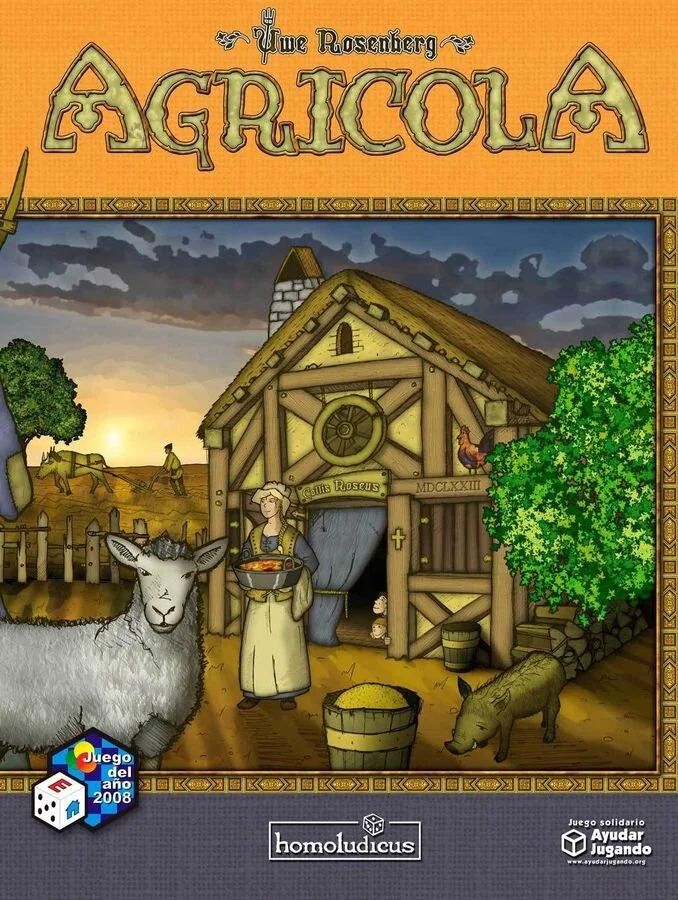
I purchased Agricola because I wanted to look cool. That’s right, I bought a game about farming to look cool. Just look at that box art, what’s cooler than that?
AGRICOLA
Z-Man Games - 2007

picture from BoardGameGeek.com
I have a confession to make. I purchased Agricola because I wanted to look cool. That’s right, I bought a game about farming to look cool. Just look at that box art, what’s cooler than that? Agricola is one of those games that the board gamer’s board gamer talks about being the best in the industry. Words like “Ameritrash” are used to describe the two previous games I wrote about. Games that are all flash and no substance. Betrayal at House on the HIll is too random. Flash Point: Fire Rescue has all these cute images and figurines to play with and is almost as random as Betrayal! Euro games are where strategy is king. It’s difficult to be “good at” playing Betrayal and Flash Point because of the random factors, but with Agricola, the random elements can be mitigated with excellent strategy and forethought.
Agricola was designed by Uwe Rosenberg. He is the first designer I learned the name of and is one of the most well known and respected designers in the board game scene. There are actually quite a few designers in the board game world that many are fond of. Reiner Knizia, Vladmir Chvatil, Stefan Feld, Steve Jackson, just to name a few. There’s also Corey Konieczka, who I happened to go to high school with. Uwe Rosenberg is a name you’ll see associated with consistently high quality games. When I went to the store to buy Agricola I walked up to the counter like, “that’s right, I’m a legit board gamer now.”
When I got home I called up my buddy Joe Donnelly, as usual, to come over and give this thing a whirl. With previous games we were able to set up and play without much issue. We had someone teach us Betrayal at House on the Hill and Flash Point: Fire Rescue isn’t exactly a mind bender. A little bit of hubris lead us to having a completely horrible experience with our first game of Agricola.
The game is all about creating a sustainable farm, growing crops and tending to livestock to ensure the survival of your family for the coming seasons. You accomplish this by assigning your family members to various tasks. Each player has their own personal board where they manage their farmstead, you will never interact with another player’s farm. Instead, fights happen on the central board where all the available actions are located. This is what’s known as a “worker placement” game. For example - say it’s my turn and I want to go to the forest to chop some wood. I grab one of my workers from my home and place them on the “collect wood” action on the central board. Any wood pieces on that action now belong to me and are moved to my resource pool. Next, it is Joe’s turn. He also wants wood but he is unable to take the “collect wood” action because I already have a worker there. Instead, he takes his next best option and goes to collect some food from the pond. As time goes on, more actions become available like increasing the number of family members you have or collecting ore. There is also the harvest phase which requires you to not only reap your crops but to also feed your family. If you are unable to feed your family at the end of a season then you must suffer the consequences.
Joe and I suffered those consequences many times in our first game. Agricola is shockingly brutal. Despite its cute box art and lovely components it will slam your face in manure and hold it there if you aren’t careful. Planning many turns ahead is paramount. Having alternative plans is necessary. One misplaced worker could mean the difference between feast or famine. We also realized we got most of the rules wrong. The game introduced mechanics completely foreign to us. There are no dice like the previous two games I wrote about and most things are an abstract representation rather than a modeled token. While the cubes and cylinders didn’t add to the complexity of the game it was a visually different experience.
Our second game was entirely different from our first. Our final scores were markedly higher and we managed to get most of the rules right. We knew we could still do better so we reset and played again. And again. And again. Each game ends right when you feel like you’re about to break through and have an amazing harvest in the next season. This is clearly by design. It leaves you wanting to go right back in to it because you know what you did wrong and you’re positive you can get to that perfect harvest one season earlier. Of course, putting that perfect strategy to action is easier said than done because surely someone is going to swoop in and take that wood right out from under your nose when you needed it most.
Uwe Rosenberg designed a spiritual successor to Agricola called Caverna. It plays nearly identically to Agricola, there’s just more. You start with a humble farmstead and you work to grow it and your family by choosing actions from a shared board. There are plenty of actions to choose from and so many ways to score points that it’s pretty easy to pivot and change course. It is far less brutal than Agricola, even new players don’t seem to have much difficulty feeding their families in their first game. In that way I almost prefer Caverna to Agricola, it is less demoralizing for new players on their first game. The amount of options is also where Caverna fails and Agricola succeeds. A new player looking at a fully set up Caverna is easily overwhelmed, whereas a fully set up Agricola isn’t nearly as huge and intimidating. With so many options there is almost no conflict for resources in Caverna. You don’t have to pay as much attention to other player’s turns because even if someone takes the wood you wanted there are two or three other ways to collect the same resource. For this reason, Caverna can sometimes feel like a group of people playing their own games alone rather than a shared game together.
Agricola isn’t a game that hits the table very often. I’ll bring it around to a board game night but the set up and clean up time is often just too much trouble to bother with. Yet, I still love it and when people ask me what my favorite games are I’ll often add Agricola to the list. While games like Betrayal at House on the Hill and Flash Point: Fire Rescue got me in to board games because of their accessibility, Agricola pulled me in deeper with its rewarding experience. Agricola certainly wouldn’t be considered a gateway game, it lets other games do that. Instead, once you’re through the gate, it will shut it and lock it behind you.
10 Board Games in 10 Days - Day 2 - Flash Point: Fire Rescue
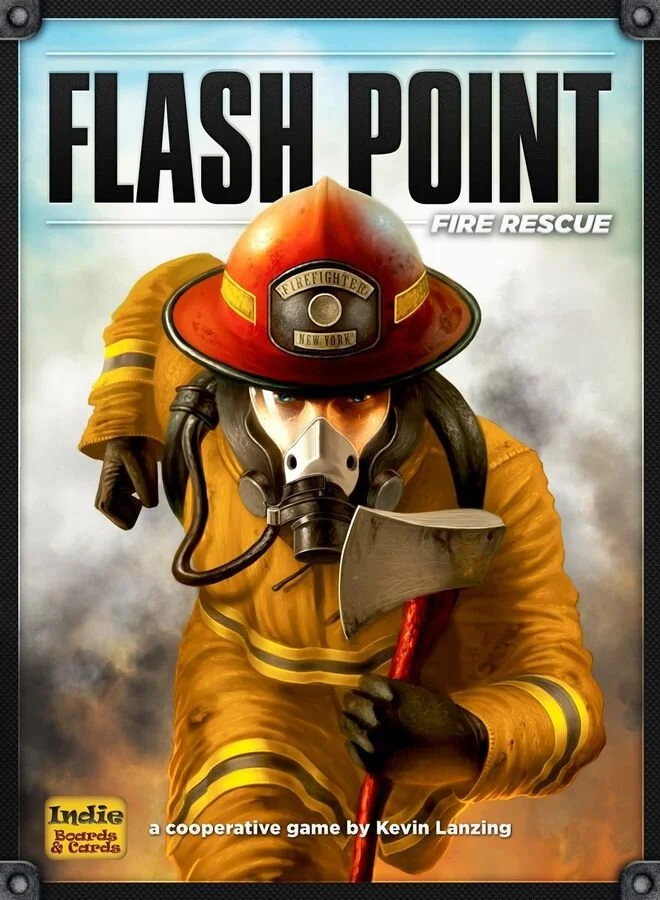
Flash Point: Fire Rescue isn’t my first experience with a purely cooperative game but it is definitely the one I’ve played the most.
FLASH POINT: FIRE RESCUE
Indie Boards & Cards - 2011

picture from BoardGameGeek.com
Flash Point: Fire Rescue is a purely cooperative board game. There’s no backstabbing, no individual winners, no points tallied at the end. You either win as a team or fail as a team. It’s not the first board game designed this way but it’s the one I’ve played the most. My first experience with cooperative board games was with Pandemic, which plays similarly to Flash Point.
Pandemic pits the players, as you can imagine, against a global pandemic. Actually, there are 4 viruses or diseases spreading around the world. Each player takes control of a different specialist. Maybe you excel at helping other players move around the board or maybe you can share information more easily, that sort of thing. A player takes their turn using action points to move and hopefully remove virus markers from the board. When they are finished it’s the board’s turn to act. You draw cards from a deck which tell you were to place new virus cubes. There are also event cards which may cause additional cubes to be places or maybe no cubes at all! If you get too many cubes in one region you have an outbreak, which causes the disease to spread faster and wider. if you’re especially unlucky you could chain together outbreaks and then you’re in serious trouble. The players win if they are able to eradicate all 4 viruses. The game wins if you run out of cubes or if the deck of cards depletes.
Flash Point operates in a very similar fashion. Each player assumes the role of a fire fighter. There are two modes of play you can use - one where everyone is just a generic fire fighter with no special abilities and in the other everyone has a unique role with specific actions they can take. I prefer the latter because I think giving a player special actions makes them feel important and can help keep their interest in the game. The former may cause one player to assume control of the game in an attempt to optimize play.
This leads me to my biggest issue with cooperative games, it’s very easy for an experienced player to push others aside and take command. Everyone wants to win and to win often requires performing the optimal move, so I completely understand why someone might try to tell others how to take their turn. However; player autonomy is important. Without it why play with your friends at all? Discussing moves as a team is encouraged, of course, but one player taking control is a problem.
Between these two games I’ve always preferred Flash Point because it was subject I could wrap my head around. I didn’t know what it was like to be part of a pandemic but I could very easily imagine being in a house fire. Of course now I know exactly what being in a pandemic feels like but even still I think I prefer Flash Point mostly for reasons I would normally look over in other games. Pandemic uses cubes to represent the various diseases whereas Flash Point uses tokens with graphics and miniatures. Don’t get me wrong, I love games with cubes. Many games I’m going to talk about in future posts are mostly just cubes you move around. Both games have very similar gameplay so really the pieces are the tie breaker and, lets face it, moving around a little fireman and flipping fire tokens is more fun to look at than a pawn and some cubes.
Flash Point: Fire Rescue is often game I’ll break out for people who haven’t played a modern board game outside of Settlers of Catan. People love the cooperative aspect, it’s so different from the board games we grew up with. Much like my biggest reason for loving Betrayal at House on the HIll, Flash Point: Fire Rescue creates an amazing narrative in your mind. It’s easy to imagine you’re a fire fighter actually running in to the building and doing heroic deeds. Or being so brazen to smash down a wall only to realize later that had you just gone around and used the door maybe the building would still be standing. I have so many fun memories with this game it’s impossible to choose just one, which is all you can ask for in a board game.
What is this?
I am a freelance photographer and this blog is about my life as such. Sometimes I just need to vent. Sometimes I need to write down my thoughts to remind myself how I should be working. Other times I might just want to write about how I love my dog.
Why is this?
I believe it's important to get your thoughts out of your head sometimes. Some people write a journal for their own safe keeping. Other see therapists. I'm going to share my thoughts with the public. Feel free to communicate with me!